
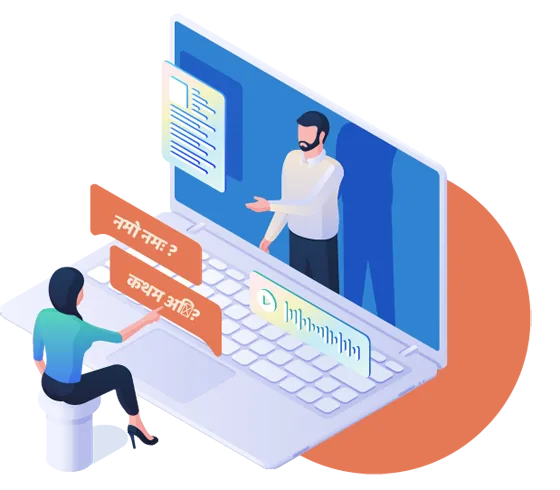
The course at a glance
DURATION / TIMINGS

- 36 hours of live teaching
- Pace agreed with you
WHERE / HOW?

- Live on Zoho Meeting, from anywhere
- Batches capped at 10 students
- Every class recorded for revision
ELIGIBILITY

- Anyone can join
- No prior knowledge about the language needed
COURSE OUTCOME

- Knowing basics of Sanskrit
- Student will be able to understand and converse in simple Sanskrit
- This course will enable the student to read simple shlokas
- One will have enough vocabulary used in day to day life
Course Curriculum
How progress is measured
Small batches mean every student's work is actually seen. Nothing here is automated. Ms. Parikh marks it herself.
| What | How often | What it checks |
|---|---|---|
| Reading aloud | Weekly | Pronunciation and script fluency |
| Written worksheet | Weekly | Declension, conjugation, sandhi |
| Module test | End of each module (5 in all) | Retention and application |
| Translation task | Weekly from Module 4 | Applied grammar |
| Final assessment | Week 18 | Reading, writing, translation and speaking |
| Written report | End of course | Where you stand, and readiness for Intermediate |
What it costs
One price for one hour of live teaching. It comes down as the group grows.
3 modules of 12 hours · 36 hours in total
You pay for the hours you take, one stage at a time, and nothing commits you to the rest. The hours are a guide rather than a fixed track: if one part of the course matters more to you, we spend longer there and move more briskly elsewhere. You can also join at whichever stage matches where you already are. Want something different altogether? Design your own course, at the same rates.
| Module | Hours | On your own | Two or three, each | Four or more, each |
|---|---|---|---|---|
| Module 1, script and sound Most students start here | 12 | ₹4,788 $180 | ₹3,000 $144 | ₹2,280 $108 |
| Module 2, first sentences | 12 | ₹4,788 $180 | ₹3,000 $144 | ₹2,280 $108 |
| Module 3, grammar that carries you on | 12 | ₹4,788 $180 | ₹3,000 $144 | ₹2,280 $108 |
| All three modules, if you take them all | 36 | ₹14,364 $540 | ₹9,000 $432 | ₹6,840 $324 |
That last row is simply the hours added up, at ₹190 an hour per person in India, or $9 outside India, in a group of four or more.
One session is one hour, so the hours above are also the number of classes. There is no second number to work out. Every session is live and recorded for you. Worksheets, marked work and a certificate of completion are included. How often you meet is arranged with you, around your timetable and ours.
Frequently asked questions
Further reading
You already know more Sanskrit than you think. Twenty words, and how the language is built.
The Devanagari script, the first steps that matter, and how to choose a course.
Why it is called the most scientific language, and how it connects to Hindi and the languages spoken today.
Same script, much of the same vocabulary, and two genuinely different languages.
How to learn Sanskrit cases without memorising 24 boxes for every noun.
Where this sits in the Sanskrit path
This is the first of three graded courses. Most students carry straight on to the next; nobody has to.
📖 Intermediate Sanskrit
Sandhi, samasa, participles and voice. Where the language stops being a set of rules and starts reading like a language.
📜 Advanced Sanskrit
Read the Gita and classical texts in the original, with all ten lakaras and compound analysis.
🗣️ Spoken Sanskrit
Speak from the first lesson. Runs alongside any of the graded courses rather than after them.
Also taught by Ms. Parikh
Learning Sanskrit makes Hindi easier, and the reverse is true too, much of Hindi school grammar is Sanskrit underneath. Taking a second subject? The second subject’s sessions are 15% off.
🧒 Hindi for Children
Ages 5 to 14, small groups. For children who understand Hindi at home but can't read it.
📚 School Hindi Tuition
CBSE, ICSE, State Boards, IGCSE and IB, with grammar explained from its Sanskrit roots.
🌏 Learn Hindi Online
For adults: travel, work, family, or watching films without subtitles.