
Most children who say prayers learned them by ear, from someone who also learned them by ear
The words drift a little with every generation, and the meaning is rarely passed on at all. By ten, a child can recite five prayers fluently and cannot tell you what a single line says. This course fixes both halves.
The prayer list
Twenty-one prayers and the Hanumān Cālīsā, each with who it is addressed to, the language it was written in, when it is said and what it asks. Every one is taught for correct pronunciation and meaning in its own language. Families choose which ones go into their child's course.
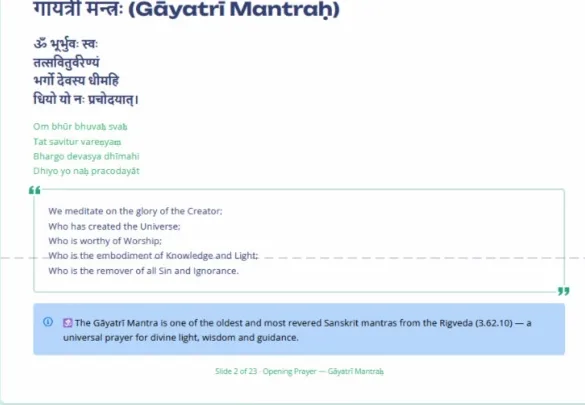
Hear the everyday prayers, chanted by Ms. Parikh
Slowly and clearly, with the Devanagari, the transliteration and the meaning on screen. This is the pronunciation your child learns.
Every day
The prayers a child says in the course of an ordinary day.
| Prayer | Addressed to | Language | When it is said, and what it asks |
|---|---|---|---|
| Gāyatrī Mantra ▶ Hear it chanted | Savitṛ, the sun | Sanskrit | The morning prayer. Asks that the mind be illumined and guided towards what is right. |
| Samudra-vasane ▶ Hear it chanted | Mother Earth | Sanskrit | Said on waking, before the feet touch the floor. Asks the Earth, who wears the oceans as her garment, to forgive the touch of our feet. |
| Brahmārpaṇam ▶ Hear it chanted | The food, and the act of eating | Sanskrit, Gītā 4.24 | Said before a meal. Sees the food, the eater and the eating as one offering. A moment of stillness before the first mouthful. |
| Rāmaṁ Skandaṁ ▶ Hear it chanted | Rāma, Skanda, Hanumān and the other protectors | Sanskrit | Said at bedtime. Names the protectors, and asks for a peaceful night. |
| Karpūra-gauram ▶ Hear it chanted | Śiva | Sanskrit | The verse that closes every ārati. The one a child has heard most often at the temple and knows the tune of before the words. |
Study and knowledge
The prayers of the classroom and the school assembly.
| Prayer | Addressed to | Language | When it is said, and what it asks |
|---|---|---|---|
| Sarasvatī Namastubhyam | Sarasvatī | Sanskrit | Said before study begins. Asks for success in learning, and marks the line between playtime and study time. |
| Yā Kundendu | Sarasvatī | Sanskrit | The Sarasvatī vandanā sung at school assemblies. Describes the goddess of learning and speech, white as jasmine and the moon. |
| Vidyā Dadāti Vinayam | No deity, a subhāṣita | Sanskrit | Two lines on how learning gives humility, humility gives worth, and worth rightly used brings happiness. The moral verse every school child learns. |
The deities
The verses to Gaṇeśa, the goddesses, Hanumān, Kṛṣṇa and Śiva.
| Prayer | Addressed to | Language | When it is said, and what it asks |
|---|---|---|---|
| Vakratuṇḍa Mahākāya | Gaṇeśa | Sanskrit | Said before any beginning. The first shloka most children learn. Asks that obstacles be removed from every undertaking. |
| Sarva-maṅgala-māṅgalye | Durgā | Sanskrit, Devī Māhātmya | The best-known Durgā verse. Asks the giver of all auspiciousness for protection. |
| Namastestu Mahāmāye | Lakṣmī | Sanskrit | A verse of thanks to the goddess of prosperity, for home and shelter. |
| Annapūrṇe Sadāpūrṇe | Annapūrṇā | Sanskrit | The prayer to the one who feeds all. Asks, as alms, for knowledge and detachment. |
| Manojavaṁ | Hanumān | Sanskrit | The Hanumān dhyāna verse: swift as the mind, fast as the wind, master of the senses. A favourite with children for its energy. |
| Vasudeva-sutaṁ | Kṛṣṇa | Sanskrit | The Kṛṣṇa dhyāna verse: son of Vasudeva, destroyer of Kaṁsa, joy of Devakī, teacher of the world. |
| Acyutāṣṭakam | Kṛṣṇa | Sanskrit | Eight verses attributed to Ādi Śaṅkara. The rhythm children memorise fastest. |
| Mahā-mṛtyuñjaya | Śiva | Sanskrit | The prayer for well-being and freedom from fear. Taught in plain recitation, for pronunciation and meaning. |
| Hanumān Cālīsā | Hanumān | Awadhi, not Sanskrit | Forty verses on Hanumān’s strength and devotion, by Tulsīdās. The piece families abroad ask for most. |
Peace, for everyone
Two verses said at the start of a class and at the end of a prayer.
| Prayer | Addressed to | Language | When it is said, and what it asks |
|---|---|---|---|
| Oṁ Saha Nāvavatu | No deity. Teacher and student together | Sanskrit | Said at the start of a class. Asks that teacher and student be protected together, learn together, and never quarrel. |
| Sarve Bhavantu Sukhinaḥ | All beings | Sanskrit | The universal peace verse. May all be happy, may all be free from illness, may none suffer. |
Jain prayers
The daily prayers of Jain households, three of them in Prakrit.
| Prayer | Addressed to | Language | When it is said, and what it asks |
|---|---|---|---|
| Navkār Mantra | The five supreme beings | Prakrit | The foundational Jain prayer, said on waking and before anything. Bows to the five, and asks nothing. |
| Khāmemi Savva Jīve | All living beings | Prakrit | The forgiveness verse. I forgive all beings; may all beings forgive me; I have friendship with all, enmity with none. |
| Maṅgalaṁ Bhagavān Vīro | Mahāvīra, and the four auspicious ones | Sanskrit | The maṅgala verse said at the opening of a gathering or a lesson. |
| Bhaktāmar Stotra, selected verses | Ādinātha, the first Tīrthaṅkara | Sanskrit | Mānatuṅga’s hymn, in vasantatilakā metre. Selected verses for older children; the full text for adults. |
Recordings of each prayer in Ms. Parikh's voice, slow and at pace, are given to every child in the course. The Gāyatrī, the Mahā-mṛtyuñjaya and Oṁ Saha Nāvavatu are taught in the plain recitation used in daily prayer, not in Vedic intonation.
Three stages, and a short one for competitions
Children are placed by what they can already do, not by birthday. Each stage has a default set of prayers, and any piece can be swapped for another from the list.
🏆 Competition preparation · any age · 8 sessions
For a child entered in a school or community shloka competition, or one of the Gītā chanting competitions held every autumn. Competitions are scored on memory, pronunciation, presentation and metre, and pronunciation is the largest part of the score a child can still improve in the final month.
The eight sessions take the exact piece the competition has set, drill it to the rubric, and rehearse the child in front of a camera and then a small audience.
Not sure which stage fits? That is what the free demo is for. It includes a short placement chat, and if your child already says a prayer at home, have them bring it.
How the classes run
Eight children, maximum
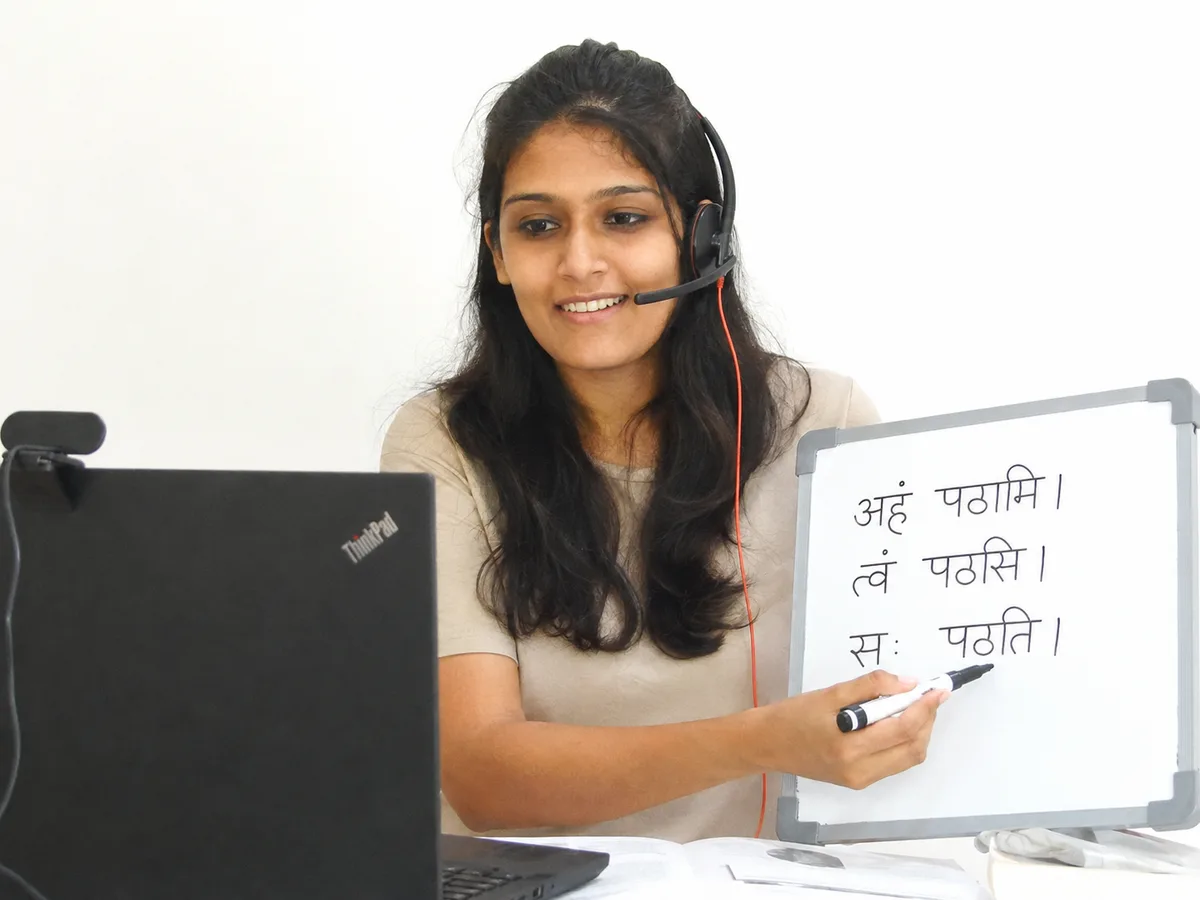
Small enough that every child recites aloud and is corrected individually, every class.
Twice a week, an hour
Live on Zoho Meeting, times arranged around your zone. For the youngest, the hour is two halves: chant, then play.
Every class recorded
Shared the same day, with the audio for each prayer. Children replay them at home.
Online, or in Borivali West
Every class is taught by Ms. Parikh herself. Small in-person batches for children also run at her home in Borivali West, Mumbai, in the afternoons: tuition at Borivali West.
How progress is measured
Small batches mean every student's work is actually seen. Nothing here is automated. Ms. Parikh marks it herself.
There is no exam, and there will not be one. Progress is measured and reported.
| What | How often | What it checks |
|---|---|---|
| Recitation check | Every class | Accuracy, sound, rhythm, confidence |
| When-and-why check | Every 2 sessions | Can the child say when the prayer is said and what it asks |
| Meaning check | Weekly from Stage 2 | Can the child explain it line by line in their own words |
| Written worksheet | Weekly from Stage 2 | Script and vocabulary |
| Prayer milestone | Every 4 sessions | The specific prayers learned |
| Stage review | End of each stage | Written note to parents, with a recording of the child reciting |
The stage recording is worth the fee on its own for most families. It is your child, at seven, saying the prayers you grew up with, correctly.
What it costs
One price for one hour of live teaching. It comes down as the group grows.
3 stages of 24 hours · 72 hours in total, and you can join at any stage
You pay for the hours you take, one stage at a time, and nothing commits you to the rest. The hours are a guide rather than a fixed track: if one part of the course matters more to you, we spend longer there and move more briskly elsewhere. You can also join at whichever stage matches where you already are. Want something different altogether? Design your own course, at the same rates.
| Stage | Hours | On your own | Two or three, each | Four or more, each |
|---|---|---|---|---|
| Stage 1, ages 5 to 7 Most families start here | 24 | ₹9,576 $360 | ₹6,000 $288 | ₹4,560 $216 |
| Stage 2, ages 8 to 10 | 24 | ₹9,576 $360 | ₹6,000 $288 | ₹4,560 $216 |
| Stage 3, ages 11 to 14 | 24 | ₹9,576 $360 | ₹6,000 $288 | ₹4,560 $216 |
| All three stages, if you take them all | 72 | ₹28,728 $1,080 | ₹18,000 $864 | ₹13,680 $648 |
That last row is simply the hours added up, at ₹190 an hour per person in India, or $9 outside India, in a group of four or more.
One session is one hour, so the hours above are also the number of classes. There is no second number to work out. Every session is live and recorded for you. Worksheets, marked work and a certificate of completion are included. How often you meet is arranged with you, around your timetable and ours. The competition module is 8 sessions, at the same rates.
Questions parents usually ask
Further reading
The four Vedas in words a child can hold, nine Upaniṣad stories by age, and six lines worth learning.
Nine shlokas in a sensible order, with what each one says and how to actually teach it.
The script both Sanskrit and Hindi use, and the order in which a child should meet its letters.
Start with a free class
A free 45-minute session, live with Ms. Parikh, including a short chat to find the right starting point. If your child already says a prayer at home, have them bring it. Hearing it is the fastest way to tell you what a trained ear hears.