
Every asana name is a sentence, not a label
Once you can see the parts, the names stop being sounds to memorise and start describing the pose.
trikoṇāsana
tri (three) + koṇa (angle) + āsana (seat, posture)
Literally the three-angle posture. The same tri as in "triangle": Sanskrit and English share an ancestor.
adho mukha śvānāsana
adho (downward) + mukha (face) + śvāna (dog) + āsana
Downward-facing dog. The ś is not an English "sh". It is made further forward in the mouth.
bhujaṅgāsana
bhujaṅga (serpent) + āsana
Cobra. That opening bh is aspirated, a genuine puff of breath. Say bu- and you have said something else.
Learn roughly forty root words and you can decode almost any pose name you meet, including ones you have never heard before.
What the sessions cover
Built around what you actually use. Nothing here is academic for its own sake.
Sounds first
The sounds English does not have, aspirated consonants, retroflex versus dental, long versus short vowels, practised until they are automatic rather than remembered.
Asana names
The root words that build pose names, so you can pronounce and explain any of them, and correct a name you have been given wrongly.
Chanting and invocations
Oṁ, the Pātañjali invocation, śānti mantras and the common opening and closing chants, with meaning, metre and correct pronunciation.
The texts themselves
The Yoga Sūtras of Patañjali and the Bhagavad Gītā in the original, reading what they say rather than choosing between translations.
Hear the Pātañjali invocation
Yogena cittasya, the verse many classes open with, chanted slowly by Ms. Parikh with the Devanagari, the transliteration and the meaning on screen. Both verses, as they are traditionally said together.
This is the standard the sessions work to: every syllable, every long vowel, every aspirate where it belongs.
For yoga schools and teacher training programmes
Most 200- and 500-hour syllabuses include Sanskrit terminology, and most cover it in an afternoon because there is nobody on the faculty qualified to teach it properly. Trainees leave able to recite the names but not to pronounce them, and the gap is passed on to the next generation of teachers.
A Sanskrit module can be taught directly to your trainee cohort, live online, scheduled around your course calendar, and pitched at the level your syllabus requires.
Qualifications, teaching background and references are available for your records. Tell us your dates and cohort size and we will propose a structure.
Enquire about a school module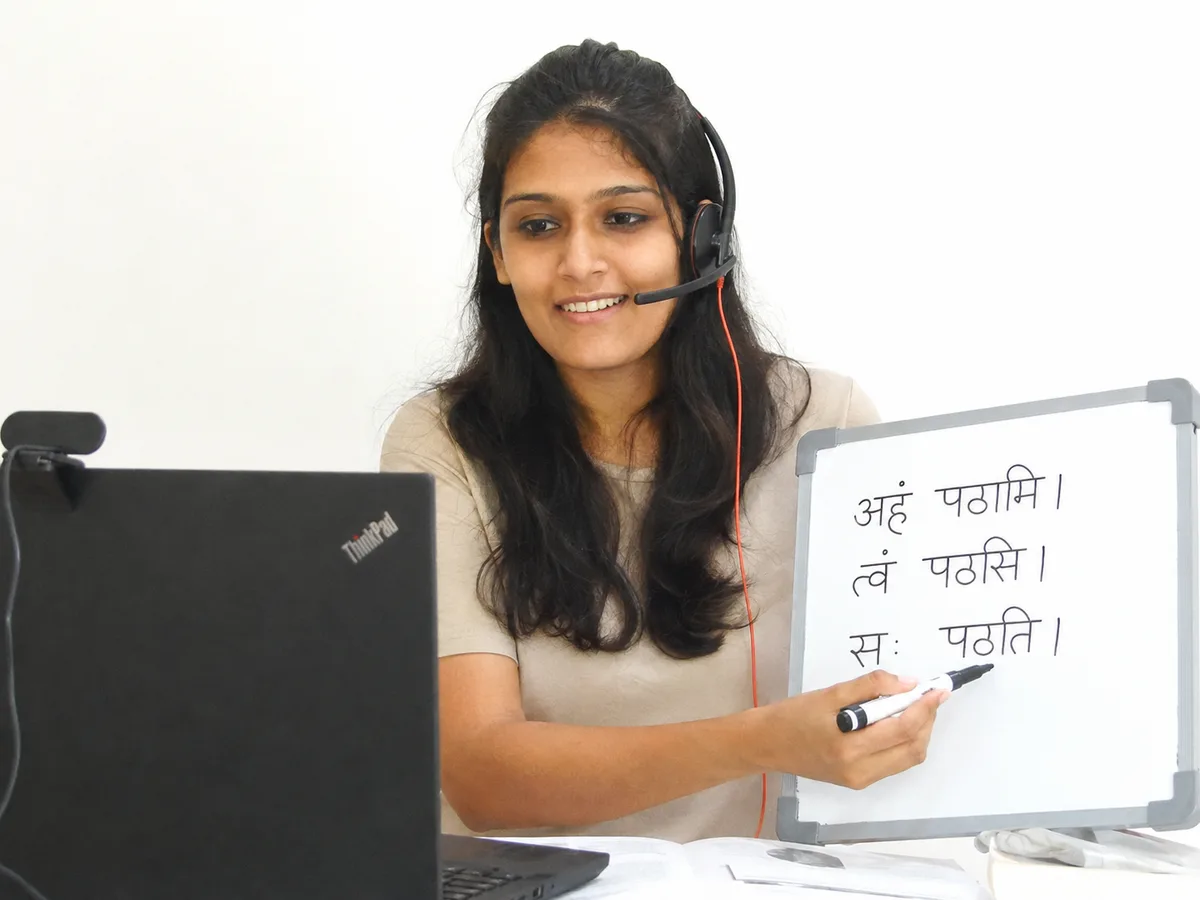
How progress is measured
Small batches mean every student's work is actually seen. Nothing here is automated. Ms. Parikh marks it herself.
There is no exam. Progress is measured against what you can do in front of a class.
| What | How often | What it checks |
|---|---|---|
| Listening discrimination | Modules 1 and 3 | Can you hear the difference |
| Recorded pronunciation | Weekly | Production, marked individually |
| Name explanation | Module 2 | Can you break a pose name down and explain it |
| Chanting assessment | Module 3 | Accuracy, rhythm, confidence |
| Teaching simulation | End of Modules 2 and 3 | Cueing and leading a chant as you would in class |
What it costs
One price for one hour of live teaching. It comes down as the group grows.
8 modules of 10 hours · 80 hours in total
You pay for the hours you take, one stage at a time, and nothing commits you to the rest. The hours are a guide rather than a fixed track: if one part of the course matters more to you, we spend longer there and move more briskly elsewhere. You can also join at whichever stage matches where you already are. Want something different altogether? Design your own course, at the same rates.
| Module | Hours | On your own | Two or three, each | Four or more, each |
|---|---|---|---|---|
| Each module Most teachers take three or four | 10 | ₹3,990 $150 | ₹2,500 $120 | ₹1,900 $90 |
| All eight modules, if you take them all | 80 | ₹31,920 $1,200 | ₹20,000 $960 | ₹15,200 $720 |
That last row is simply the hours added up, at ₹190 an hour per person in India, or $9 outside India, in a group of four or more. Most teachers take three or four modules rather than all eight. The whole-course row is the full set.
One session is one hour, so the hours above are also the number of classes. There is no second number to work out. Every session is live and recorded for you. Worksheets, marked work and a certificate of completion are included. How often you meet is arranged with you, around your timetable and ours. Most teachers take the first module or two on their own and stop there, which is a perfectly good place to finish.
Questions teachers ask
Further reading
The Sanskrit names you say out loud every class, and what goes wrong with them.
Om, namaste, shanti, prana, hatha.
Bring three words you are unsure about
The free session is 45 minutes, live and at no cost. Bring the names you have never been confident saying, and you will leave saying them correctly, whether or not you book anything afterwards.