Bhagavad Gītā for Children

Ages 7 to 14. They learn to recite it properly, and, unlike most children who recite it, to know what they are saying.

Batches of eight. Two classes a week, an hour each. Taught by Ms. Ishita Parikh, who has an MA in Sanskrit, a Gītā certificate from ISKCON Kurukshetra, and two teaching diplomas in how young children actually learn.

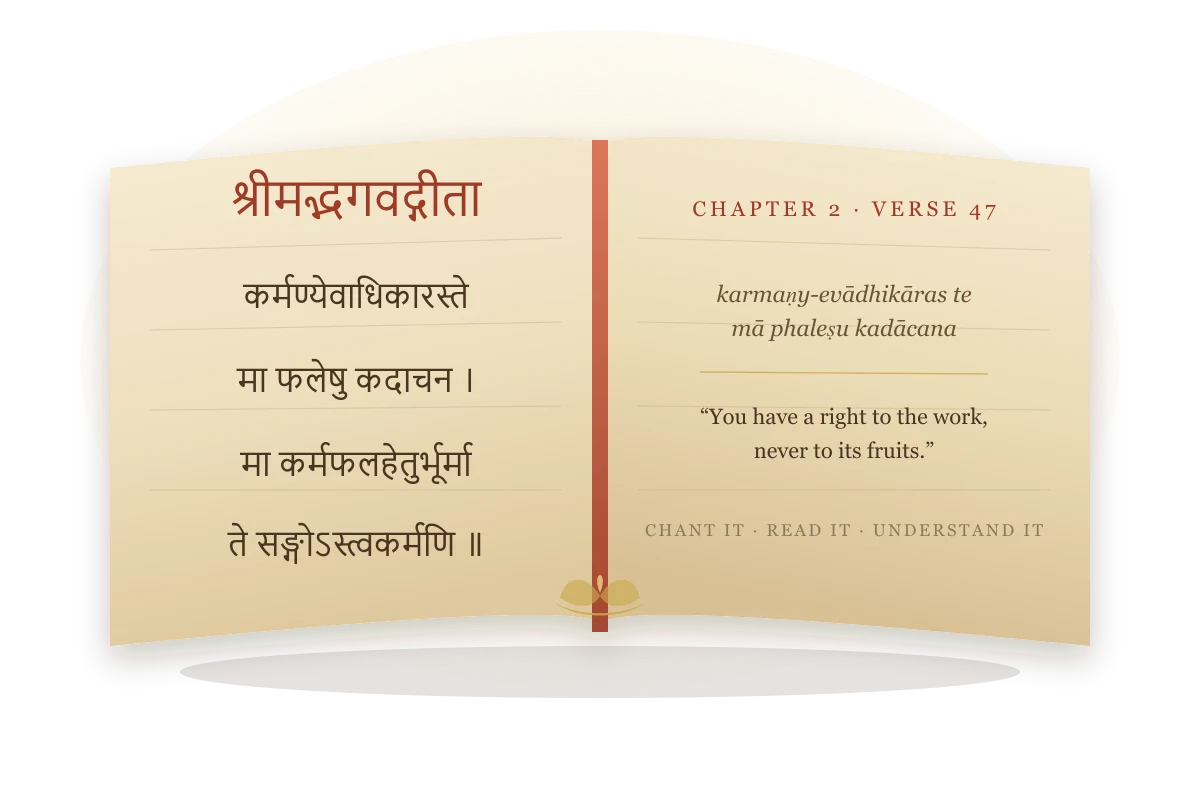
An open manuscript showing Bhagavad Gita chapter 2 verse 47 in Devanagari with its transliteration and meaning

Most children who recite shlokas have no idea what they mean

This is not anyone's fault. A child learns the sounds long before the sense, which is exactly how it has always worked and how it should start. The trouble is when it never moves on, and the recitation becomes a performance the child does for adults rather than something they own.

Two things change that. Getting the sounds genuinely right, so the verse is worth reciting. And finding out what the words say, so there is a reason to.

Children turn out to like the second part far more than parents expect. The Gītā opens with a young man refusing to do the thing everyone says he must, which is not a hard sell to a twelve-year-old.

Why parents sign a child up

🎤

Recitation competitions

School and community shloka competitions are judged on pronunciation and clarity, which is precisely what gets drilled here.

🏠

Family and festivals

A child who can recite confidently at a family gathering, and answer when a grandparent asks what it means.

🧠

Memory and focus

Learning metrical verse by heart is unfashionable and genuinely good for a child's memory. Two verses a week adds up quickly.

📗

A head start on Sanskrit

The ear, the script and a lot of vocabulary, all of which make school Sanskrit easier when it arrives in Class 6.

Three stages, by age and by what they can already do

Children are placed by what they can do, not by birthday. The free demo includes a short placement chat.

STAGE 1 · AGES 7–9

Śiśu: sound and story

Chapter 15 and chapter 12, learned by ear. Short verses, strong rhythm, one story every session.

  • ✅ Two verses a week, recited back and corrected
  • ✅ The sounds English does not have, taught as a game
  • ✅ A story behind every verse, in English
  • ✅ Devanagari letters recognised, not written yet
  • ✅ No homework beyond reciting to a parent

By the end: recites around 20 verses clearly, from memory.

STAGE 2 · AGES 10–12

Bāla: meaning arrives

The famous verses of chapter 2, 2.13, 2.20, 2.22, 2.47, 2.62–63, plus finishing chapter 12.

  • ✅ Reading Devanagari properly, about 8 hours
  • ✅ Word by word: what each piece of the line means
  • ✅ Where the words split, the first taste of sandhi
  • ✅ The argument of chapter 2, as a story with two people in it
  • ✅ Writing verses out, which is how the script sticks

By the end: recites a verse and explains it in their own words.

STAGE 3 · AGES 13–14

Kiśora: how the verse works

Full chapters rather than selections, and the grammar underneath them.

  • ✅ Complete chapters: usually 12, then 2, then 15
  • ✅ Noun cases and verb endings, the school Sanskrit overlap
  • Anuṣṭubh metre: why the rhythm is fixed
  • ✅ Comparing two English translations and spotting the gap
  • ✅ Working out an unseen verse without being told

By the end: reads a new verse and works out the sense unaided.

Older teenagers and adults are better served by the adult Gītā course, which moves faster and goes further.

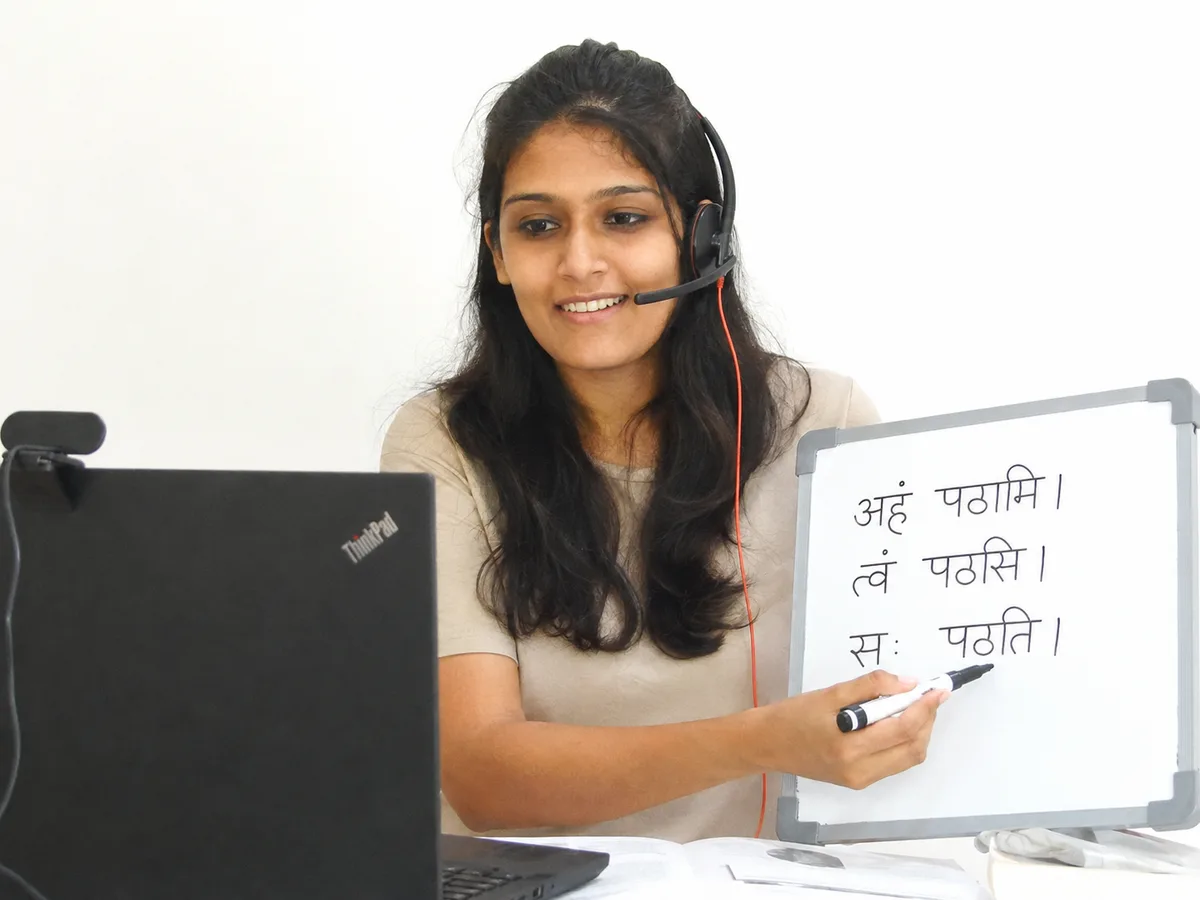
Ms. Ishita Parikh teaching Sanskrit verb forms on a whiteboard in a live online class

Trained in the text, and in teaching children

Shloka classes for children usually come from someone who knows the verses well and has never been taught how a nine-year-old learns. Ms. Parikh has both, formally and examined.

🕉️ Bhagavad Gītā Course: ISKCON Kurukshetra, 2024
👩‍🏫 Pre-Primary Teachers' Training: Grade A+, Distinction (76.5%)
Vidhyanidhi Education Society, Mumbai: child psychology and how children learn
🧒 Early Childhood Care and Education, Grade A, First Class
Including an assessed school practicum
🏛️ NPTEL “Elite” grade in Spoken Sanskrit, IIT Kharagpur
One of only 77 candidates certified nationwide. Verifiable
📖 MA (Acharya) in Sanskrit, 2023, Central Sanskrit University

How the classes run

👧

Eight children, maximum

Every child recites aloud and is corrected individually, every class.

🕐

Twice a week, an hour

Live on Zoho Meeting, at a time arranged around your zone. How often you meet is agreed with you.

📹

Every class recorded

So a child can replay a verse at home as often as they need.

👩‍🏫

Always the same teacher

Every class taught by Ms. Parikh herself. No rotating tutors.

How progress is measured

Small batches mean every student's work is actually seen. Nothing here is automated. Ms. Parikh marks it herself.

There is no exam, and there will not be one. Progress is measured and reported.

What How often What it checks
Recitation check Every class Accuracy, sound, rhythm, confidence
Meaning check Weekly from Stage 2 Can the child explain it in their own words
Written worksheet Weekly from Stage 2 Script and vocabulary
Verse milestone Every 2 weeks The specific verses learned
Stage review End of each stage Written note to parents, with a recording of the child reciting

For most families the stage recording is worth the fee on its own. It is a record of what a child could do at eleven.

What it costs

One price for one hour of live teaching. It comes down as the group grows.

3 stages of 32 hours · 96 hours in total

On your own
One to one, built around you
₹399
in India
$15
outside India
per hour
Two or three of you
Learn with friends or family
₹250
in India
$12
outside India
per person, per hour
Best value
A group of four or more
Our small batch, capped at ten
₹190
in India
$9
outside India
per person, per hour
Shaped around you

You pay for the hours you take, one stage at a time, and nothing commits you to the rest. The hours are a guide rather than a fixed track: if one part of the course matters more to you, we spend longer there and move more briskly elsewhere. You can also join at whichever stage matches where you already are.

Stage Hours On your own Two or three, each Four or more, each
Stage 1, ages 7 to 9
Most families start here
32 ₹12,768
$480
₹8,000
$384
₹6,080
$288
Stage 2, ages 10 to 12 32 ₹12,768
$480
₹8,000
$384
₹6,080
$288
Stage 3, ages 13 to 14 32 ₹12,768
$480
₹8,000
$384
₹6,080
$288
All three stages, if you take them all 96 ₹38,304
$1,440
₹24,000
$1,152
₹18,240
$864

That last row is simply the hours added up, at ₹190 an hour in India or $9 outside India, in a group.

Your first class is free. A real lesson with Ms. Parikh, not a sales call. Nothing is paid until you have taken it and decided to carry on.

One session is one hour, so the hours above are also the number of classes. There is no second number to work out. Every session is live and recorded for you. Worksheets, marked work and a certificate of completion are included. How often you meet is arranged with you, around your timetable and ours.

Questions parents ask

Seven is a sensible floor. Below that, children can certainly repeat sounds, but they cannot yet hold a verse and its meaning together, and the class stops being useful. Between 7 and 9 it is recitation and stories; meaning comes properly from about 10.

Yes, and many do, including children with no Indian background at all. Everything is explained in English, and the first stage uses roman transliteration rather than Devanagari. Children who already recite at home usually start a little further along.

No. Children learn to recite the verses correctly, hear the story they sit inside, and find out what the words mean. Nobody is told what to believe. Parents who want the devotional side handled at home or at the temple can have it that way, and often do.

Usually two things. The first is pronunciation, verses picked up by ear drift, and a child who has recited for years is often surprised at what a trained ear catches. The second is meaning: most children who recite have no idea what they are saying, and that is the part that makes it stick.

It helps, though it is not a substitute. Gita verses build the ear for Sanskrit sounds, the Devanagari script and a good deal of vocabulary, all of which make the CBSE or ICSE syllabus easier. For actual exam preparation, see our Sanskrit classes for children, which follow the school textbook.

Never more than 8. Classes run twice a week for 60 minutes, live on Zoho Meeting, and are taught by Ms. Parikh herself every time. The cap matters here because every child has to recite aloud and be corrected individually.

One to one it is ₹399 a session in India, or $15 outside India. In a group of four or more it is ₹190 per person per session in India, or $9 outside India. Every session is 60 minutes, live, and the first class is free.See all fees.

Start with a free class

A free 45-minute session, live with Ms. Parikh, including a short placement chat. If your child already recites something, have them bring it.