
Repairing a memorised foundation is faster than parents expect. It is one term of work, not a lost year.
Boards and classes taught
Tuition follows your child’s own syllabus and prescribed textbook, not a generic Sanskrit course.
What it costs
One price for one hour of live teaching. It comes down as the group grows.
Sold in blocks of 12 hours, for as long as your child needs
You pay for the hours you take, one stage at a time, and nothing commits you to the rest. The hours are a guide rather than a fixed track: if one part of the course matters more to you, we spend longer there and move more briskly elsewhere. You can also join at whichever stage matches where you already are. Want something different altogether? Design your own course, at the same rates.
| What you buy | Hours | On your own | Two or three, each | Four or more, each |
|---|---|---|---|---|
| One block of 12 hours Buy another whenever you need it | 12 | ₹6,588 $240 | ₹4,188 $192 | ₹3,228 $144 |
That is simply the hours added up, at ₹269 an hour per person in India, or $12 outside India, in a group of four or more.
One session is one hour, so the hours above are also the number of classes. There is no second number to work out. Every session is live, and taught by Ms. Parikh herself. Classes are not recorded, so if a class is missed a compensation class is arranged instead. Worksheets, marked work and a certificate of completion are included. How often you meet is arranged with you, around your timetable and ours. That is the board-year rate, and it applies to Classes 9 to 12 on any board. Classes 1 to 8 are at the standard rate of ₹399 in India or $15 outside, per session one to one, and ₹190 or $9 per person in a group of four or more.
How progress is measured
Small batches mean every student's work is actually seen. Nothing here is automated. Ms. Parikh marks it herself.
| What | How often | What it checks |
|---|---|---|
| Diagnostic check | At the free demo | Reading speed, and whether the tables are understood or memorised |
| Written worksheet | Weekly | Script, declension, conjugation |
| Translation task | Weekly | Applied grammar, both directions |
| Module test | End of each module | Retention |
| Past paper | Monthly | Exam readiness and timing |
| Progress report | End of each block | Written note to parents, with next steps |
Questions parents ask
Is Sanskrit really an easier third language to score in?
Usually yes, and the reputation is deserved. The grammar is regular, so rules genuinely apply instead of dissolving into exceptions, the paper keeps a predictable shape year to year, and much of the marking rewards accuracy rather than interpretation. The catch is that this only holds while the grammar is understood. A student who memorises tables scores well until about Class 8, then meets a paper asking them to apply rules to words they have never seen.
My child is in Class 9 and suddenly dropping marks in Sanskrit. What happened?
This is the single most common reason families get in touch, and it is almost never a drop in effort. It is a foundation built on memory rather than understanding finally running out. Up to Class 8 a good memory carries a student through shabd and dhatu rupa. From Class 9 the paper asks for unseen translation and applied grammar, where a memorised table is no help. The fix is to go back and teach the pattern behind the tables, which is faster than it sounds.
Which boards and classes do you teach?
Any board, Classes 1 to 12, including both board years. CBSE, ICSE, SSC, the state boards, IGCSE and international curricula. At Classes 11 and 12 that covers CBSE Sanskrit Core and Sanskrit Elective. Lessons follow your child's own prescribed textbook rather than a generic Sanskrit course.
Should my child choose Sanskrit or another third language?
Choose Sanskrit if your child is comfortable with patterns and rules, because that is what the subject rewards. It is a poor choice if it is picked purely to avoid a harder-looking language, since the grammar is substantial from Class 8 onward. One honest test: a child who enjoys mathematics usually takes to Sanskrit grammar, because both are systems where a small number of rules generate a large number of correct answers.
Do the classes assume my child already knows Devanagari?
No. Reading is checked at the free demo and taught properly if it is shaky. A surprising number of students reaching Class 8 are still decoding letters slowly, which quietly costs them time in every paper they sit.
Are the explanations in Hindi or English?
English, unless a family prefers otherwise. Sanskrit taught through Hindi assumes a level of Hindi that many students outside the Hindi belt do not have, and it turns one subject into two.
How are classes taught, and by whom?
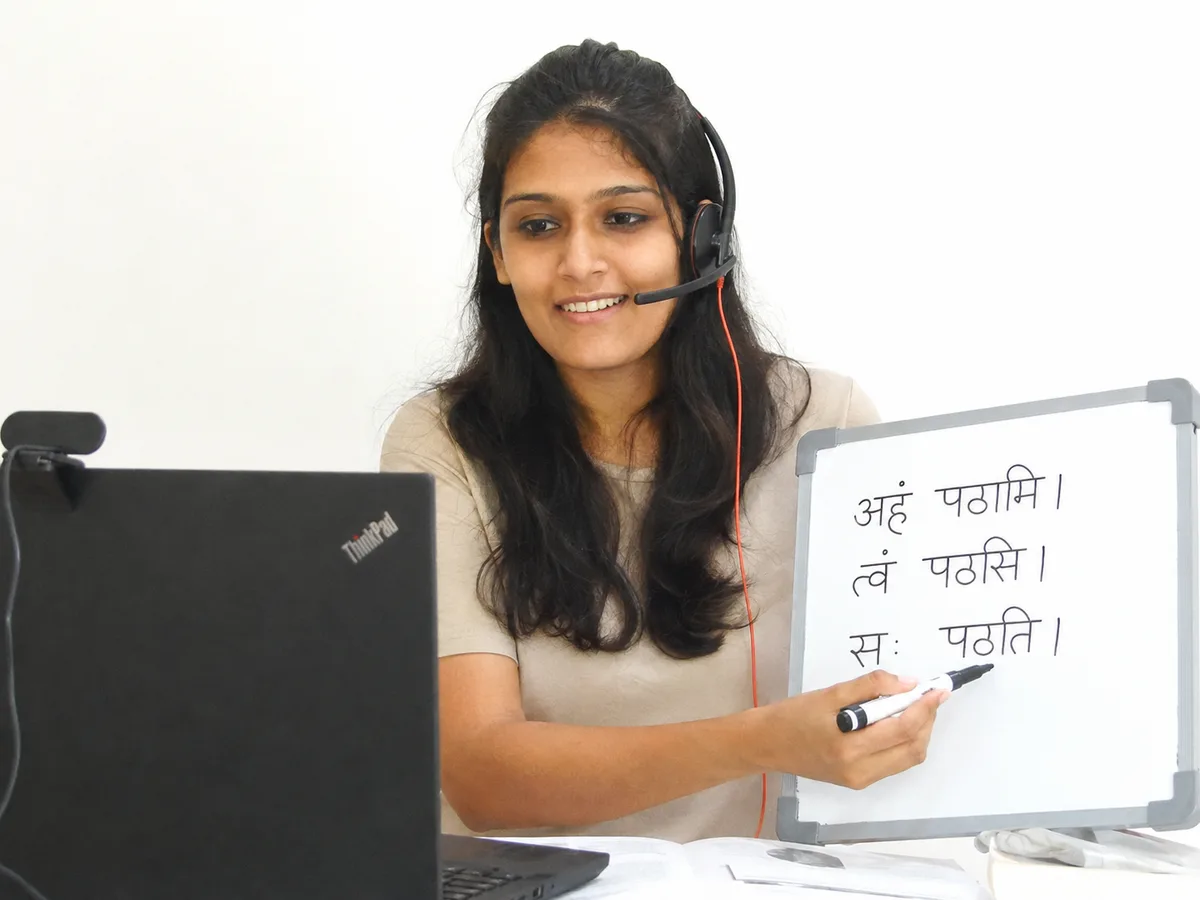
Live on Zoho Meeting, in small batches or one to one, and every class is taught by Ms. Ishita Parikh herself. Nothing is pre-recorded and there are no assistant teachers. School tuition is not recorded. If your child misses a class, a compensation class is arranged, so a missed lesson is not a lost one.
Further reading
Where the marks actually sit in the paper, and which sections repay preparation most.
What the first year covers, and what to get right before Class 7 makes it harder.
How to learn Sanskrit cases without memorising 24 boxes for every noun.
Classes 1 to 10 on any board, and shloka classes for children, at the teacher's home in small afternoon batches.
The official syllabus, section by section: the nine Shemushi chapters, the 25 grammar marks topic by topic, the composition tasks, and the five places marks are lost.
From 2026-27 NCERT's Deepakam replaces Ruchira Part 2.
NCERT's new Class 9 book Sharada, and the official 2026-27 paper: 80 marks section by section, the nine grammar topics with their exact lists, and what changed.
From 2026-27 NCERT's Deepakam replaces Ruchira Part 3 for Class 8 Sanskrit: the twelve lessons, the grammar the year must finish before Class 9, and where marks go.
Start with a free class
A free 45-minute session, live, at no cost, including an honest look at whether your child’s Sanskrit is understood or memorised. Nothing is paid until after it.