
Three age bands, 12 sessions each
A child starts in the band that fits their age. The free demo includes a short placement chat. Under eight, the hour is split into story, activity and the line.
A line from the texts, with each story
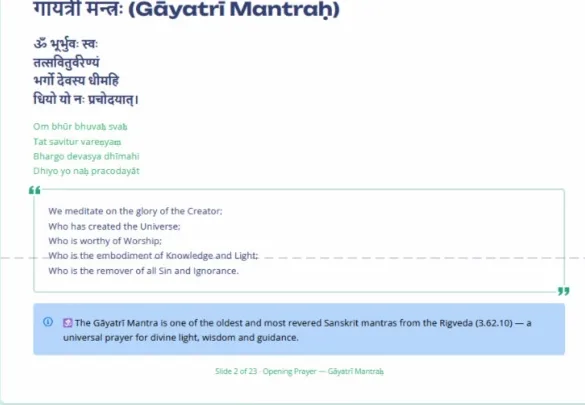
Short, famous, and said correctly from the first session. Three of the lines children learn:
सत्यं वद । धर्मं चर ।
satyaṁ vada, dharmaṁ cara
Speak the truth. Do what is right.
Taittirīya Upaniṣad 1.11.1
सत्यमेव जयते ।
satyam eva jayate
Truth alone wins.
Muṇḍaka Upaniṣad 3.1.6
उत्तिष्ठत जाग्रत प्राप्य वरान्निबोधत ।
uttiṣṭhata jāgrata prāpya varān nibodhata
Arise, awake, and learn from those who know.
Kaṭha Upaniṣad 1.3.14
How the classes run
Told, then retold
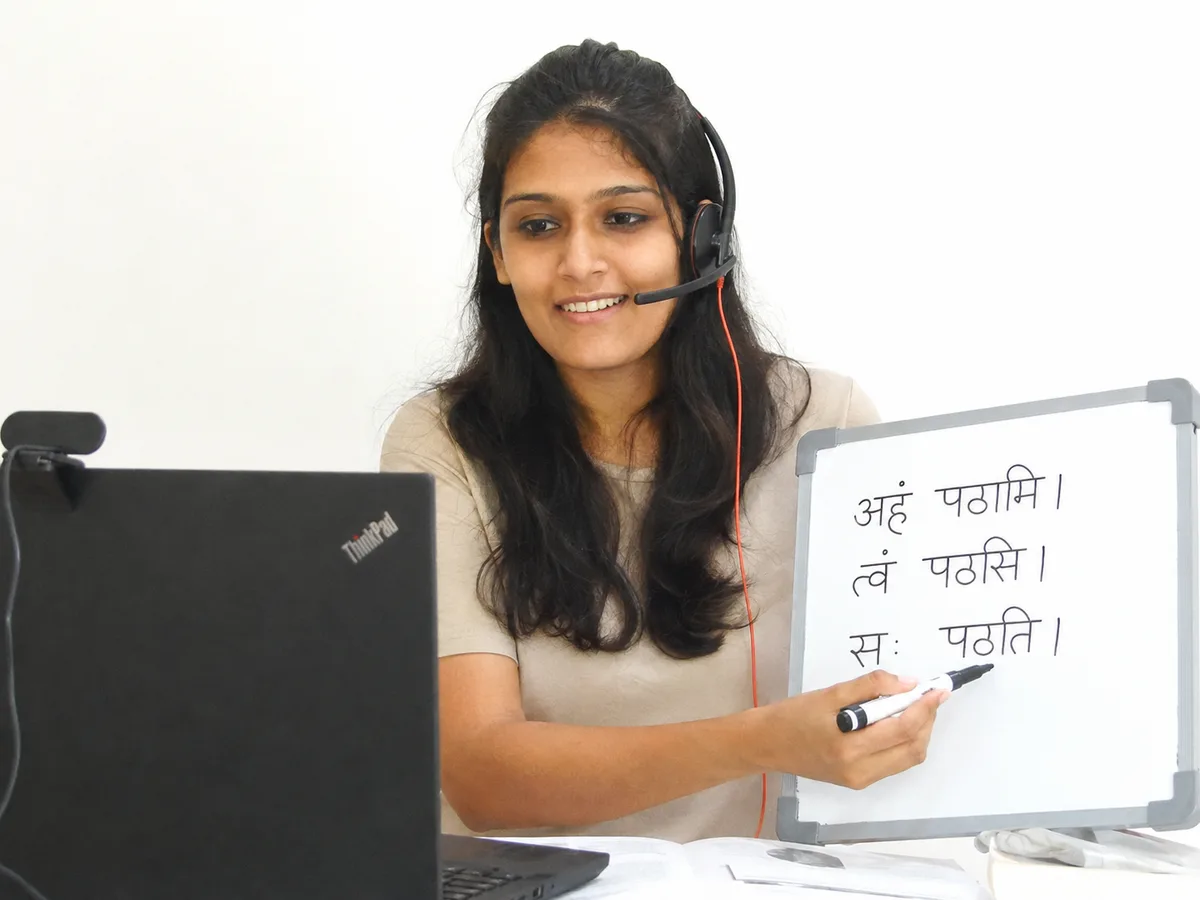
Each story is told the way it was told to students, then the child tells it back.
Lines said correctly
Every child says each line aloud and is corrected, from the first session.
Live online only
On Zoho Meeting, at times arranged around your time zone. Classes are not recorded.
Always the same teacher
Every class taught by Ms. Parikh herself. A missed class is made up with a compensation class.
How progress is measured
Small batches mean every student's work is actually seen. Nothing here is automated. Ms. Parikh marks it herself.
There is no exam. Progress is checked in the class and reported.
| What | How often | What it checks |
|---|---|---|
| Retelling | Every story | Can the child tell it back in their own words |
| Line check | Every class once a line is learned | Pronunciation and meaning of the lines learned |
| Band review | End of the 12 sessions | Written note to parents: the stories the child can retell and the lines they can say |
What it costs
One price for one hour of live teaching. It comes down as the group grows.
3 age bands of 12 sessions · a child starts in one band
You pay for the hours you take, one stage at a time, and nothing commits you to the rest. The hours are a guide rather than a fixed track: if one part of the course matters more to you, we spend longer there and move more briskly elsewhere. You can also join at whichever stage matches where you already are. Want something different altogether? Design your own course, at the same rates.
| Band | Hours | On your own | Two or three, each | Four or more, each |
|---|---|---|---|---|
| Ages 5 to 7, pictures Start with the band for your child's age | 12 | ₹4,788 $180 | ₹3,000 $144 | ₹2,280 $108 |
| Ages 8 to 11, questions | 12 | ₹4,788 $180 | ₹3,000 $144 | ₹2,280 $108 |
| Ages 12 to 14, conversations | 12 | ₹4,788 $180 | ₹3,000 $144 | ₹2,280 $108 |
| All three bands, if you take them all | 36 | ₹14,364 $540 | ₹9,000 $432 | ₹6,840 $324 |
That last row is simply the hours added up, at ₹190 an hour per person in India, or $9 outside India, in a group of four or more. A child takes the band that fits their age; the other bands are there to move up to.
One session is one hour, so the hours above are also the number of classes. There is no second number to work out. Every session is live, and taught by Ms. Parikh herself. Classes are not recorded, so if a class is missed a compensation class is arranged instead. Worksheets, marked work and a certificate of completion are included. How often you meet is arranged with you, around your timetable and ours.
Questions parents ask
Is this religious instruction?
No. Children hear the stories, learn what the lines say and talk about the questions the stories raise. Nobody is told what to believe. Families who want the devotional side handled at home or at the temple can have it that way.
Does my child learn Vedic chanting?
No. Vedic chanting with its pitch accents is taught teacher to student within particular traditions, and traditions differ on who learns it and when. Here the lines are learned in plain recitation, for correct pronunciation and meaning.
My child does not know any Sanskrit or Hindi. Can they join?
Yes. Everything is told and explained in English, and every Sanskrit line comes with a roman transliteration and its meaning.
What age should a child start?
Five. Under eight the stories are told and acted, with one short line at a time, and the hour is split into story, activity and the line. From about eight the stories carry a question, and from twelve the children read the dialogues themselves.
How long is the course?
Each age band is 12 sessions of 60 minutes. A child starts in the band that fits their age. How often you meet is arranged with you.
Is the Bhagavad Gita part of this?
No. The Gita is part of the Mahabharata, not the Vedas, though it draws heavily on the Upanishads. Many children go on to the Bhagavad Gita for children course after this one.
Are classes recorded?
No. Classes are live only, on Zoho Meeting, and taught by Ms. Parikh herself. If your child misses a class, a compensation class is arranged.
What does it cost?
One to one it is ₹399 a session in India, or $15 outside India. In a group of four or more it is ₹190 per person per session in India, or $9 outside India. Each age band is 12 sessions, and the first class is free.
Further reading
The four Vedas in words a child can hold, the stories by age, and where chanting fits.
Nine shlokas in a sensible order, with what each one says and how to teach it.
Start with a free class
A free 45-minute session, live with Ms. Parikh, including a short placement chat to choose the band. Nothing is paid until your child has had a first class.