
Why do you want to learn Hindi?
It matters more than your level does. Someone learning for a trip needs different lessons from someone whose in-laws speak Hindi, or whose child has an exam in March.
I'm travelling to India
Speaking first, script later. Getting around, ordering, bargaining, asking for help, and understanding the reply, which is the part phrasebooks never prepare you for.
Private lessons, paced to your departure date.
I want to follow films and music
Working towards watching without subtitles and understanding what a song actually says. We use real dialogue and real lyrics, not textbook sentences nobody says out loud.
Private lessons. Expect months, not weeks, but it does happen.
My family speaks Hindi
For partners marrying into a Hindi-speaking family, and for anyone who wants to talk properly with in-laws or grandparents rather than smiling through it.
Private lessons, weighted towards listening and family conversation.
I work with India
For people relocating, managing teams, or working in research or development work. Focused on workplace conversation and the courtesies that actually matter in an Indian office.
Private lessons, scheduled around work.
It's for my child
Children aged 5 to 14 learn in their own small groups, taught by a qualified schoolteacher, playfully, and at weekends for families living abroad.
It's a school subject
CBSE, ICSE, State Boards, Cambridge IGCSE and the IB, syllabus-led tuition aimed at marks, with grammar explained from its Sanskrit roots.
The stages, and what you can do at the end of each
You don't have to start at the beginning. The free demo includes a placement chat, and we'll tell you honestly where to join.
| Stage | Hours | By the end you can… |
|---|---|---|
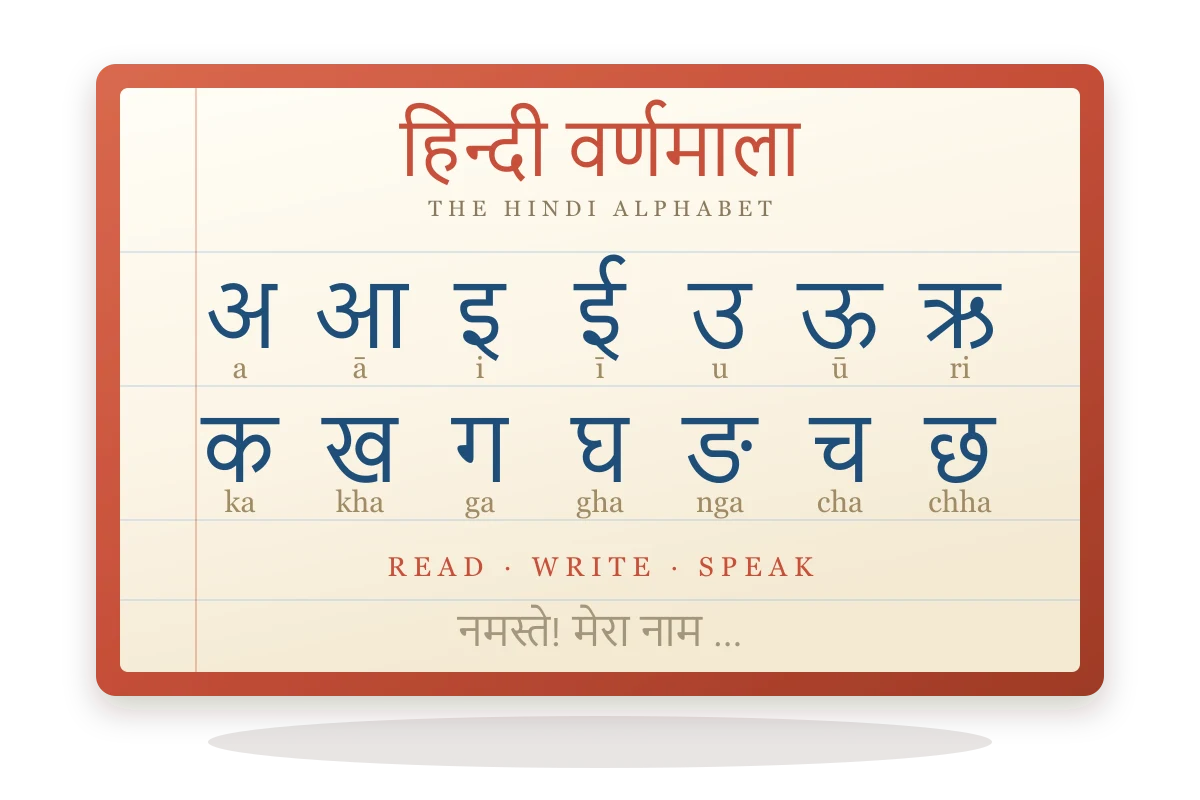
| अक्षर · Akshar Script starter | 8 hours | Read and write the whole Devanagari alphabet and the matras. This is where fluent speakers who can't read should join. |
| बोल-चाल · Bol-Chaal Everyday speaking | 24 hours | Introduce yourself, talk about family and food, shop, order, ask directions, tell the time. Present and simple past. |
| बात-चीत · Baat-Cheet Real conversation | 24 hours | Hold a ten-minute conversation. All three tenses, giving opinions, telling stories about your own life. |
| पढ़ना-लिखना · Padhna-Likhna Reading & writing | 24 hours | Read short stories and simple news; write paragraphs, messages and letters. |
| साहित्य · Sahitya Advanced | optional | Literature, idiom, and the more formal register used in writing and news. |
How progress is measured
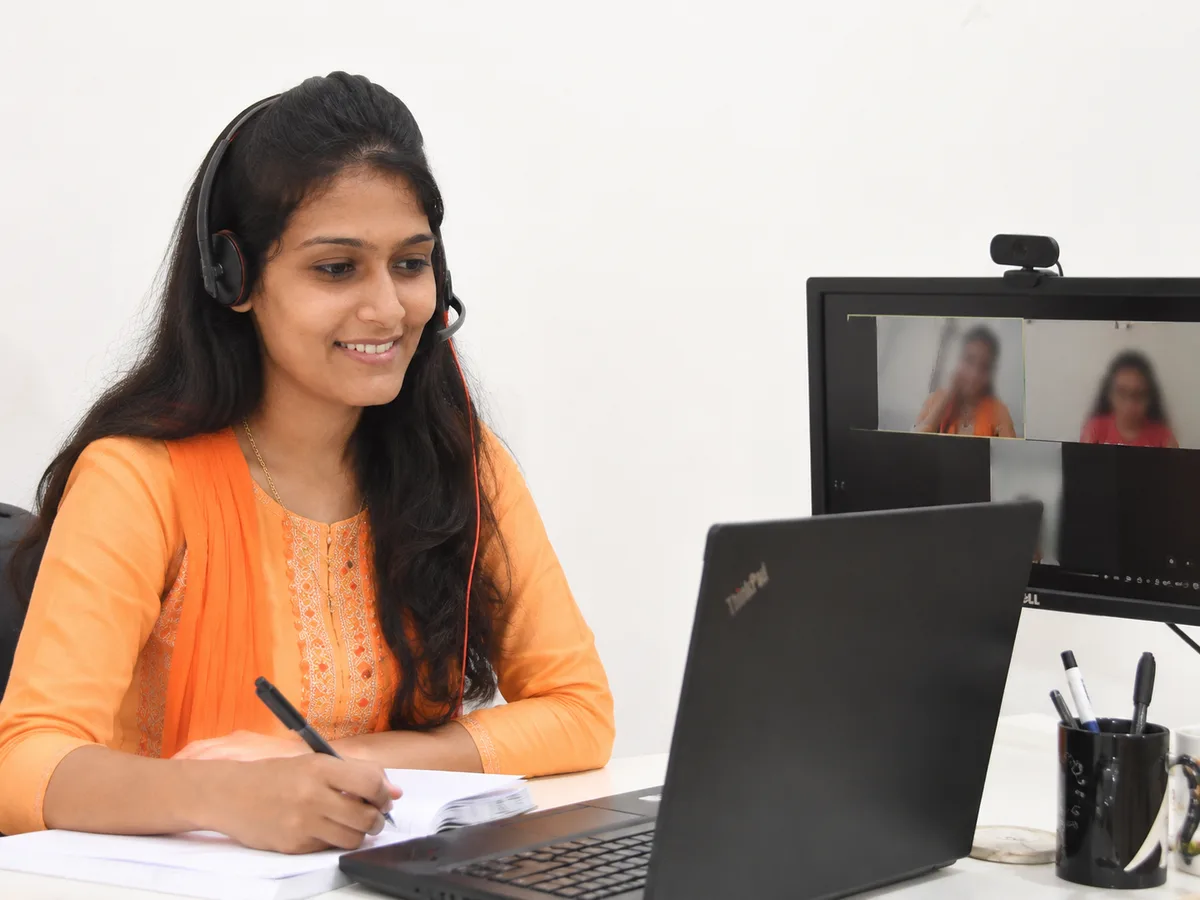
Small batches mean every student's work is actually seen. Nothing here is automated. Ms. Parikh marks it herself.
| What | How often | What it checks |
|---|---|---|
| In-class speaking | Every class | Fluency, accuracy, confidence |
| Recorded speaking task | Fortnightly | Pronunciation and sentence construction, marked with notes |
| Written worksheet | Weekly | Grammar, script, spelling |
| Reading aloud | Weekly from <em>Akṣar</em> | Fluency and accuracy |
| Level assessment | End of each level | Speaking, listening, reading and writing, with a written report |
Assessments here are diagnostic, not a hurdle. The point is to tell you precisely what to work on next.
What it costs
One price for one hour of live teaching. It comes down as the group grows.
Four stages, 80 hours in all. The speaking path is the first three, 56 hours, and you can join at any stage
You pay for the hours you take, one stage at a time, and nothing commits you to the rest. The hours are a guide rather than a fixed track: if one part of the course matters more to you, we spend longer there and move more briskly elsewhere. You can also join at whichever stage matches where you already are. Want something different altogether? Design your own course, at the same rates.
| Stage | Hours | On your own | Two or three, each | Four or more, each |
|---|---|---|---|---|
| Akshar, script starter Most adult learners start here | 8 | ₹3,192 $120 | ₹2,000 $96 | ₹1,520 $72 |
| Bol-Chaal, everyday speaking | 24 | ₹9,576 $360 | ₹6,000 $288 | ₹4,560 $216 |
| Baat-Cheet, real conversation | 24 | ₹9,576 $360 | ₹6,000 $288 | ₹4,560 $216 |
| Padhna-Likhna, reading and writing | 24 | ₹9,576 $360 | ₹6,000 $288 | ₹4,560 $216 |
| All four stages, if you take them all | 80 | ₹31,920 $1,200 | ₹20,000 $960 | ₹15,200 $720 |
That last row is simply the hours added up, at ₹190 an hour per person in India, or $9 outside India, in a group of four or more. Many adults stop after Baat-Cheet, at 56 hours, which is where comfortable conversation sits. Sahitya, the advanced stage, is optional and arranged separately.
One session is one hour, so the hours above are also the number of classes. There is no second number to work out. Every session is live and recorded for you. Worksheets, marked work and a certificate of completion are included. How often you meet is arranged with you, around your timetable and ours.
Common questions
Further reading
The sounds English does not have, and why your ear cannot hear them yet.
For families abroad whose children understand Hindi but answer in English.
The letters are not a list to memorise.
Same script, much of the same vocabulary, and two genuinely different languages.
A chair is feminine, a room is masculine, and no rule fully explains it.
Find out where you'd actually start
The free demo is a real class plus a short placement chat. No cost, and no obligation afterwards.