
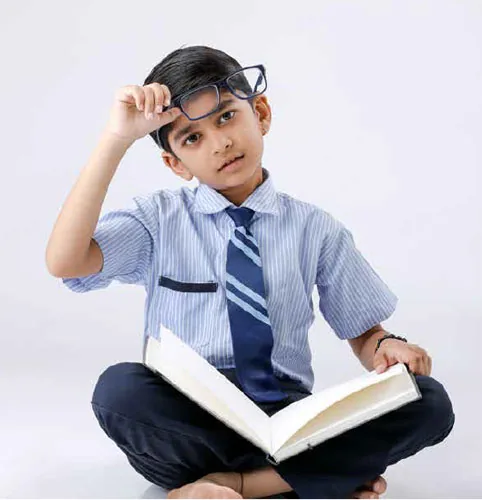
Parents come to Sanskrit for two quite different reasons
Both are good reasons. They just need different lessons, so it helps to know which one you are.
Taking Sanskrit at school?
A lot of families choose Sanskrit as the third language because it scores, and that reputation is deserved. But the marks only arrive if the grammar is understood. Students who memorise rūpa tables without knowing why the endings change hold on until about Class 8, and then the paper starts asking them to apply the rules to words they have never seen.
School tuition, on any board, has a page of its own, covering Classes 1 to 12 and both board years.
Also taking Hindi at school? That is taught here too, including CBSE, ICSE, IGCSE and IB, school Hindi tuition.
Three stages, built for how children actually learn
Children are not small adults, so they do not get an adult syllabus made shorter.
Not sure which stage fits? That is what the free demo is for, it includes a short placement chat, and we will tell you honestly where your child should start.
If your child does not take Sanskrit at school
It is still worth doing, for two reasons that are practical rather than sentimental.
It makes other Indian languages easier, not harder. Hindi, Marathi, Gujarati and Bengali all draw their grammar and much of their vocabulary from Sanskrit. A child who understands sandhi and samas in Sanskrit meets the same rules again in the Hindi paper and recognises them. Parents often notice the Hindi marks move first.
And the shlokas stop being noise. Children who grow up hearing prayers at home usually learn the sounds long before the sense. Understanding what the words say changes the relationship with them, it turns recitation into something the child owns rather than performs.
How the classes run
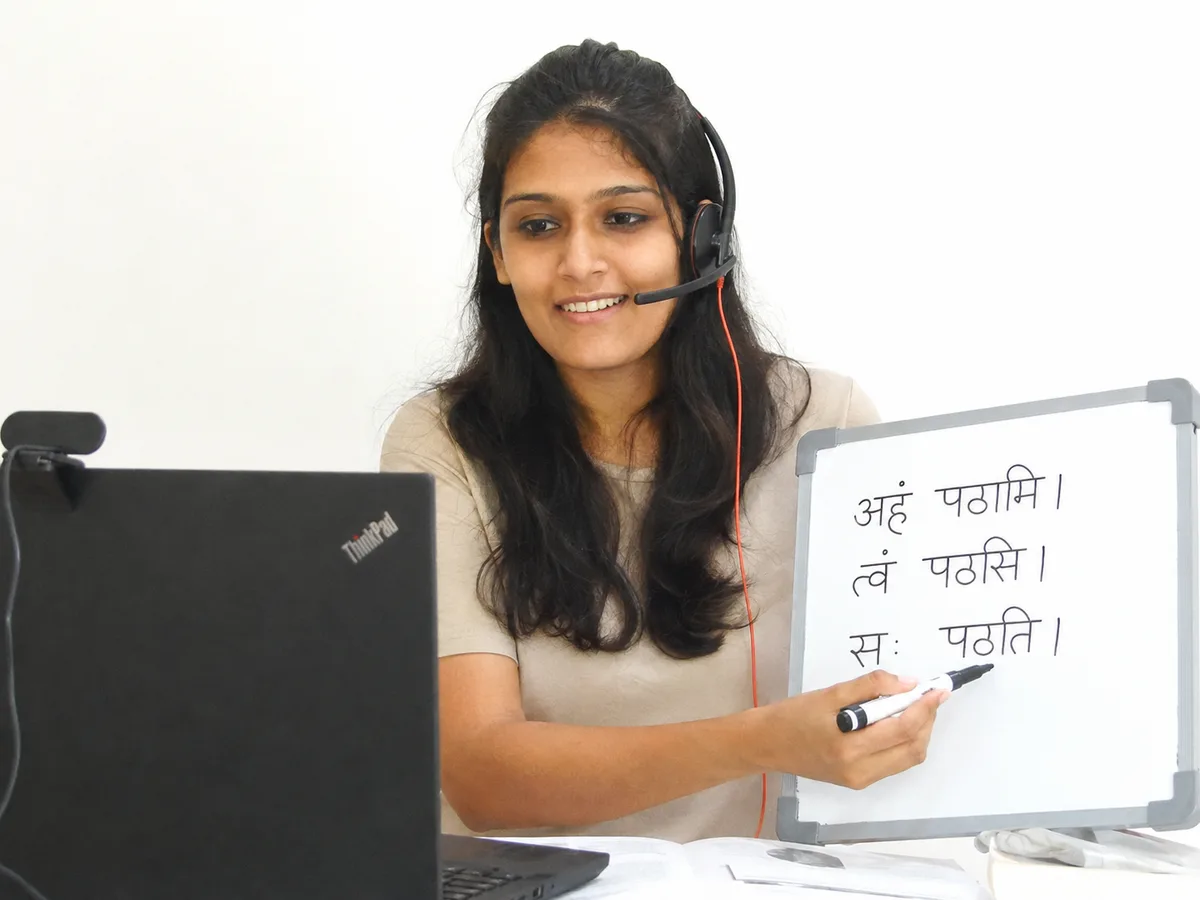
Eight children, maximum
Small enough that every child reads aloud and answers in every class.
Twice a week, an hour
Live on Zoho Meeting, times arranged around your zone. How often you meet is agreed with you.
Every class recorded
Exams, illness, holidays: the recording is always there.
Always the same teacher
Every class taught by Ms. Parikh herself. No rotating tutors.
How progress is measured
Small batches mean every student's work is actually seen. Nothing here is automated. Ms. Parikh marks it herself.
| What | How often | What it checks |
|---|---|---|
| Recitation check | Weekly | Pronunciation and clarity |
| Written worksheet | Weekly from Stage 2 | Script, declension, conjugation |
| Translation task | Weekly from Stage 3 | Applied grammar |
| Module test | End of each module | Retention |
| Past paper | Monthly, Stage 3 | Exam readiness and timing |
| Stage report | End of each stage | Written note to parents, with next steps |
What it costs
One price for one hour of live teaching. It comes down as the group grows.
3 stages · 88 hours in total, and you can join at any stage
You pay for the hours you take, one stage at a time, and nothing commits you to the rest. The hours are a guide rather than a fixed track: if one part of the course matters more to you, we spend longer there and move more briskly elsewhere. You can also join at whichever stage matches where you already are. Want something different altogether? Design your own course, at the same rates.
| Stage | Hours | On your own | Two or three, each | Four or more, each |
|---|---|---|---|---|
| Stage 1, ages 5 to 8 Most families start here | 24 | ₹9,576 $360 | ₹6,000 $288 | ₹4,560 $216 |
| Stage 2, ages 9 to 11 | 32 | ₹12,768 $480 | ₹8,000 $384 | ₹6,080 $288 |
| Stage 3, ages 12 to 14, school syllabus | 32 | ₹12,768 $480 | ₹8,000 $384 | ₹6,080 $288 |
| All three stages, if you take them all | 88 | ₹35,112 $1,320 | ₹22,000 $1,056 | ₹16,720 $792 |
That last row is simply the hours added up, at ₹190 an hour per person in India, or $9 outside India, in a group of four or more.
One session is one hour, so the hours above are also the number of classes. There is no second number to work out. Every session is live and recorded for you. Worksheets, marked work and a certificate of completion are included. How often you meet is arranged with you, around your timetable and ours. School Sanskrit for the board years, Grades 9 to 12, is ₹549 in India or $20 outside India per session one to one, and ₹269 or $12 per person in a group.
Questions parents usually ask
Further reading
What the first year of school Sanskrit covers, and the five places marks are lost every year.
The gap between 75 and 92 is rarely knowledge. It is which marks get left on the table.
How to learn Sanskrit cases without memorising 24 boxes for every noun.
Classes 1 to 10 on any board, and shloka classes for children, at the teacher's home in small afternoon batches.
Start with a free class
A free 45-minute session, live with Ms. Parikh, including a short chat to find the right starting point. If your child takes Sanskrit at school, bring a recent test paper.