
School Hindi Tuition

CBSE · ICSE · State Boards · Cambridge IGCSE · IB, any grade.

Most students don't lose Hindi marks because they didn't study. They lose them on vyakaran, sandhi, samas, tatsam and tadbhav, where they were told to memorise a list and never told why the list is what it is.

That grammar is Sanskrit grammar. Ms. Parikh has an MA in Sanskrit, so she teaches the rule, not the list.

Hindi and Vyakaran school textbooks for CBSE, ICSE, IGCSE and IB

Half of the Hindi paper is Sanskrit in disguise

Anyone who grew up speaking Hindi can tell you the right answer. Far fewer can tell you why it's right, and that gap is exactly where marks are lost.

संधि · Sandhi

विद्या + आलय = विद्यालय

Taught as a list to memorise in most classes. It's actually one consistent rule about what happens when two vowels meet, and it's a Sanskrit rule. Learn it once and you can solve pairs you've never seen.

तत्सम · तद्भव

सूर्य → सूरज

Students are asked which word came straight from Sanskrit and which changed on the way, then left to guess. Once you know how sounds actually shifted, the pairs stop being a memory test.

उपसर्ग · प्रत्यय

प्र + हार = प्रहार

Prefixes and suffixes carry meanings that barely changed from Sanskrit. Learn roughly twenty of them properly and a large part of Hindi vocabulary becomes readable on sight.

This is the one thing a coaching class down the road, or a native-speaker tutor online, genuinely cannot offer.

Boards taught

Ms. Parikh has taught Hindi for each of these. Tuition follows your child's own syllabus and prescribed textbooks, not a generic Hindi course.
🇮🇳 CBSE · ICSE · State Boards

Grades 1 to 12, including the board years.

  • ✅ Full vyakaran, sandhi, samas, alankar, ras, chhand
  • Apathit gadyansh, unseen passage technique
  • ✅ Formal letters, notices, anuchchhed and essays
  • ✅ Prescribed texts explained line by line
  • ✅ Past papers, and where marks are actually awarded

Particularly useful if you live outside the Hindi belt and Hindi is your child's second or third language.

🌍 Cambridge IGCSE · IB

For students at international schools, in India or anywhere else.

  • ✅ Cambridge IGCSE Hindi
  • ✅ IB MYP Hindi
  • ✅ IB DP: Hindi A, Hindi B and ab initio
  • ✅ Both Standard Level and Higher Level
  • ✅ Support for School-Supported Self-Taught students

Qualified Hindi tutors who know these syllabuses are genuinely scarce. More detail below.

IB Hindi, explained plainly

IB language subjects come with a lot of shorthand. Here's what it all means, so you can work out what your child actually needs.

Course Who takes it Levels
Hindi ab initio Complete beginners. Ab initio is Latin for "from the start". SL only
Hindi B Students who already have some Hindi. The usual choice for children who speak Hindi at home but haven't studied it formally. SL or HL
Hindi A Hindi as the student's best language, studied as literature rather than as language learning. SL or HL

SL and HL: what's the difference?

Every IB Diploma student takes six subjects, three at Higher Level and three at Standard Level. SL is 150 teaching hours; HL is 240. HL goes deeper, is assessed more demandingly, and in language subjects adds the study of two literary works. It is roughly sixty per cent more work, which is why HL tuition is priced above SL rather than the same.

If your child's school doesn't offer Hindi

Most IB schools don't. But that usually doesn't mean your child has to give Hindi up. There's a route called School-Supported Self-Taught, where the school supervises and enters the student for the exam, while the teaching happens outside.

The catch is that the school doesn't provide the teacher. You do. Many schools will ask to see the tutor's qualifications first, and some won't authorise the subject at all until a suitable tutor has been found.

That's a stressful position to be in, usually with a deadline attached. It's also exactly what this is for.

  • ✅ Regular one-to-one sessions built around the IB assessment calendar
  • ✅ Work on the prescribed literary texts, not general conversation
  • ✅ Qualifications and teaching background supplied for your school's records
  • ✅ Happy to speak with your school's IB or language coordinator directly
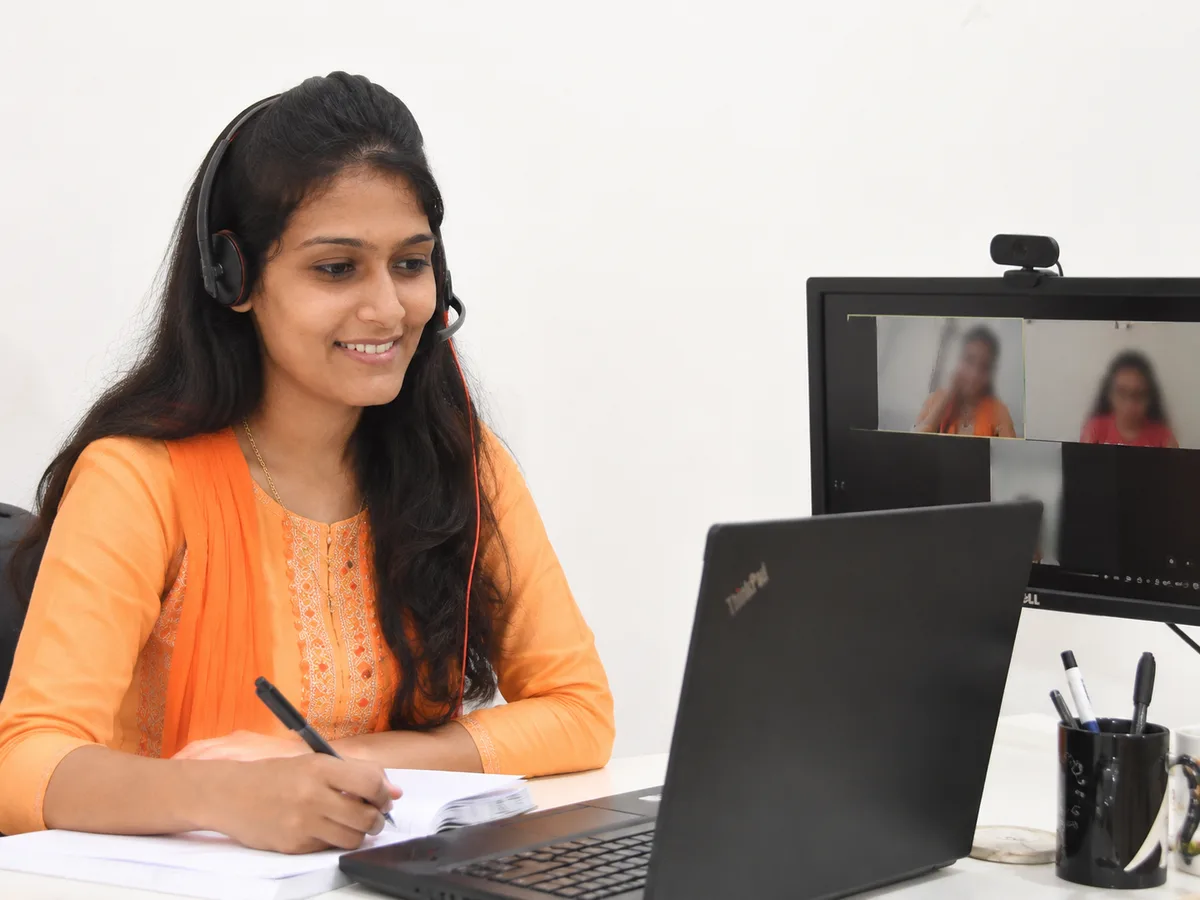
Ms. Ishita Parikh teaching a live online class, with students visible on screen

Who teaches your child

Every class is taught by Ms. Ishita Parikh herself, the same teacher each week, never an assistant and never a recording. School tuition is not recorded, so a missed class is made up with a compensation class rather than a video.

📖 MA (Acharya) in Sanskrit, 2023
Central Sanskrit University, under the Ministry of Education, the reason Hindi grammar gets explained rather than drilled
🏫 Has taught Hindi for CBSE, ICSE, Cambridge IGCSE and the IB
Including IB Diploma Hindi A, Hindi B and ab initio, at Standard and Higher Level
👩‍🏫 Trained schoolteacher
Two one-year teaching diplomas, one passed with Distinction, plus classroom years in Mumbai schools
🗣️ Hindi is her first language
Teaching in English, so students who think in English can follow the explanation

How progress is measured

Small batches mean every student's work is actually seen. Nothing here is automated. Ms. Parikh marks it herself.

What How often What it checks
Diagnostic test Week 1 Baseline, and where the marks are actually going
Topic test End of each grammar module Retention and application
Weekly writing Weekly Format, content, presentation, marked against a mark scheme
Unseen passage Weekly from Grade 6 Method under time
Chapter test After each prescribed chapter Coverage of the text
Full past paper Monthly in board years Time management, and the total score
Progress report Monthly Written note to parents with the current trajectory

For IGCSE and IB students the marking changes. Written work is marked to the band descriptors with the gap to the next band named, oral practice is recorded fortnightly, there are two full mock examinations in the final year, and the monthly report carries a predicted-grade trajectory.

What it costs

One price for one hour of live teaching. It comes down as the group grows.

Sold in blocks of 12 hours, for as long as your child needs

On your own
One to one, built around you
₹549
in India
$20
outside India
per hour
Two or three of you
Learn with friends or family
₹349
in India
$16
outside India
per person, per hour
Best value
A group of four or more
Our small batch, capped at ten
₹269
in India
$12
outside India
per person, per hour
Shaped around you

You pay for the hours you take, one stage at a time, and nothing commits you to the rest. The hours are a guide rather than a fixed track: if one part of the course matters more to you, we spend longer there and move more briskly elsewhere. You can also join at whichever stage matches where you already are.

What you buy Hours On your own Two or three, each Four or more, each
One block of 12 hours
Buy another whenever you need it
12 ₹6,588
$240
₹4,188
$192
₹3,228
$144

That is simply the hours added up, at ₹269 an hour in India or $12 outside India, in a group.

Your first class is free. A real lesson with Ms. Parikh, not a sales call. Nothing is paid until you have taken it and decided to carry on.

One session is one hour, so the hours above are also the number of classes. There is no second number to work out. Every session is live, and taught by Ms. Parikh herself. Tuition is not recorded, so if a class is missed a compensation class is arranged instead. Worksheets, marked work and a certificate of completion are included. How often you meet is arranged with you, around your timetable and ours. That is the rate for CBSE, ICSE, SSC, HSC and the state boards. IGCSE and IB Diploma Hindi are ₹729 in India or $27 outside, per session one to one, and ₹349 or $16 per person in a group.

Questions parents ask

CBSE, ICSE, State Boards, Cambridge IGCSE, the IB or any other board, at any grade. Ms. Parikh has taught Hindi for all of these. For the IB Diploma that includes Hindi A, Hindi B and Hindi ab initio, at both Standard and Higher Level.

Because most of the Hindi grammar that appears in exams is Sanskrit grammar underneath. Sandhi, samas, tatsam and tadbhav, upsarg and pratyay, alankar, ras and chhand all come from Sanskrit. A native speaker knows the right answer but often can't explain why it's right, and "why" is what turns a memorised list into something a student can apply to a question they haven't seen before. Ms. Parikh holds an MA (Acharya) in Sanskrit.

Ab initio is for complete beginners, and is Standard Level only. Hindi B is for students who already have some Hindi, the usual choice for children who speak it at home but haven't studied it formally, and is offered at SL or HL. Hindi A treats Hindi as the student's best language and is studied as literature, also at SL or HL. Higher Level means 240 teaching hours against 150, with harder assessment and two literary works.

Often yes, through the School-Supported Self-Taught route: the school supervises and enters your child, but you find the tutor. Be aware that some schools won't authorise the subject at all unless a suitable tutor is identified first, so it's worth sorting early. Ms. Parikh supports self-taught students and can provide her qualifications for the school's records, or speak to the coordinator directly.

Yes, and it matters more than most parents expect. Alongside the syllabus we work on past papers, how marks are actually awarded, apathit gadyansh technique, formal letter and notice formats, and essay structure. Plenty of students know the content and still lose marks on presentation and timing.

Not a problem: in fact it's a common reason families get in touch. Students in Tamil Nadu, Kerala, Karnataka, Bengal and the North-East often find Hindi genuinely hard because nobody at home speaks it. Explanations are given in English, and nothing is assumed about what your child has picked up at home.

For most students the small group works well and costs less, batches are capped at 10. One-to-one is the better choice close to board exams, for IB Diploma students, and for anyone with a specific weak area to fix. IB Diploma tuition is usually one-to-one, simply because the cohort is small and the syllabus is specific.

Further reading

CBSE Class 10 Hindi: where marks are actually lost

The child who speaks Hindi at home is often the one who loses marks. Here is why.

IB Hindi B assessment, explained

Not harder Hindi. Hindi assessed on different criteria, which is why strong speakers struggle.

Start with a free class

A free 45-minute session, live, at no cost, including an honest look at where your child is actually losing marks. Bring a recent test paper if you have one.