
Bhagavad Gītā, in the original

Chant it properly. Then understand what you have been saying.

Most people meet the Gītā through a translation, or through verses learned by ear. Both are worth having. Neither tells you what the Sanskrit actually says, and the Sanskrit is unusually direct once someone opens it up for you.

Taught by Ms. Ishita Parikh, MA (Acharya) in Sanskrit, NPTEL “Elite” in spoken Sanskrit, and a Bhagavad Gītā course at ISKCON Kurukshetra.

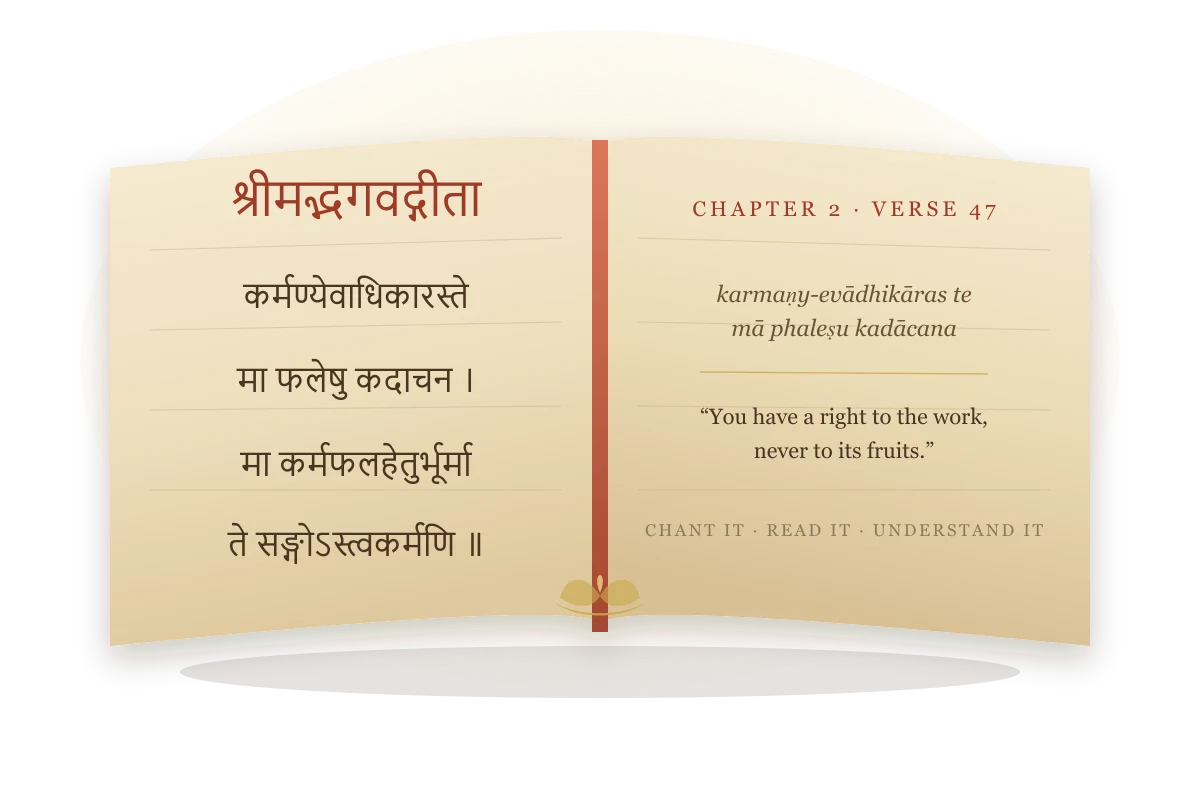
An open manuscript showing Bhagavad Gita chapter 2 verse 47 in Devanagari with its transliteration and meaning

One verse, three ways of knowing it

Take the line almost everyone can quote, karmaṇy-evādhikāras te, chapter 2, verse 47.

🔊

Recited

You can say it. It sounds right. Whether the vowel lengths and the retroflex consonants are right is a different question, and nobody has ever checked.

📖

Translated

“You have a right to the work, never to its fruits.” A good rendering, but it is somebody else's reading, and every translator's differs.

🔑

Read

Karmaṇi, in action. Eva, only. Adhikāraḥ te, your right. Four words, and the sentence assembles itself. That is what this course is for.

You do not need to reach the third column to get value from the first. Level 1 fixes the chanting and nothing else, and that alone is worth having if you recite at home or lead a group.

The curriculum, level by level

Three levels. Each one ends with something you can actually do, so stopping after any of them still leaves you ahead.

LEVEL 1 · ABOUT 24 HOURS

Chanting

Chapters 12 (Bhakti Yoga) and 15 (Puruṣottama Yoga): twenty verses each, short, melodic, and the ones traditionally learned first.

  • ✅ The five sounds English does not have, and how to make them
  • ✅ Long and short vowels, where the metre lives
  • Sandhi at word joins, so lines flow instead of stuttering
  • Anuṣṭubh metre: why the rhythm is what it is
  • ✅ Two verses a week, recited back and corrected live

You finish able to: chant two full chapters from memory, correctly.

Roman transliteration throughout. No Devanagari needed.

LEVEL 2 · ABOUT 24 HOURS

Meaning

Chapter 2 (Sāṅkhya Yoga): 72 verses, the philosophical core of the text, worked through word by word.

  • ✅ The Devanagari script: about 8 hours, taught alongside
  • Padachheda, splitting a line back into its words
  • ✅ Noun cases: who is doing what to whom, and how you can tell
  • ✅ The verses everyone quotes: 2.13, 2.20, 2.22, 2.47, 2.62–63
  • ✅ Comparing two published translations against the Sanskrit

You finish able to: take a verse you have never seen and work out what it says.

Level 1 first, or an equivalent grounding in pronunciation.

LEVEL 3 · OPEN-ENDED

Reading

Chapters chosen with the group, usually from 3, 4, 6, 9 and 18. Reading becomes a habit rather than a syllabus.

  • ✅ Longer passages read at pace, with a dictionary
  • ✅ Compound words (samāsa): the real obstacle in the Gītā
  • ✅ How a commentator reads a verse, and where readings diverge
  • ✅ Vocabulary that recurs across the whole text
  • ✅ Bring your own verse, sessions often start with one

You finish able to: open any chapter and read it, unaided.

Also suits students already reading other Sanskrit texts.

Not sure which level? The free demo includes a short placement chat, usually two minutes of chanting settles it.

Who comes to these classes

🪔

People who already recite

Daily or weekly, at home or in a group, and have never had anyone check the pronunciation.

🧘

Yoga teachers

Who quote the Gītā in class and would rather quote it accurately. See also Sanskrit for yoga teachers.

🌏

Indians living abroad

Who grew up hearing it and want to hand it on to their own children with some confidence.

📚

Readers of translations

Who have read three or four, noticed they disagree, and want to see for themselves.
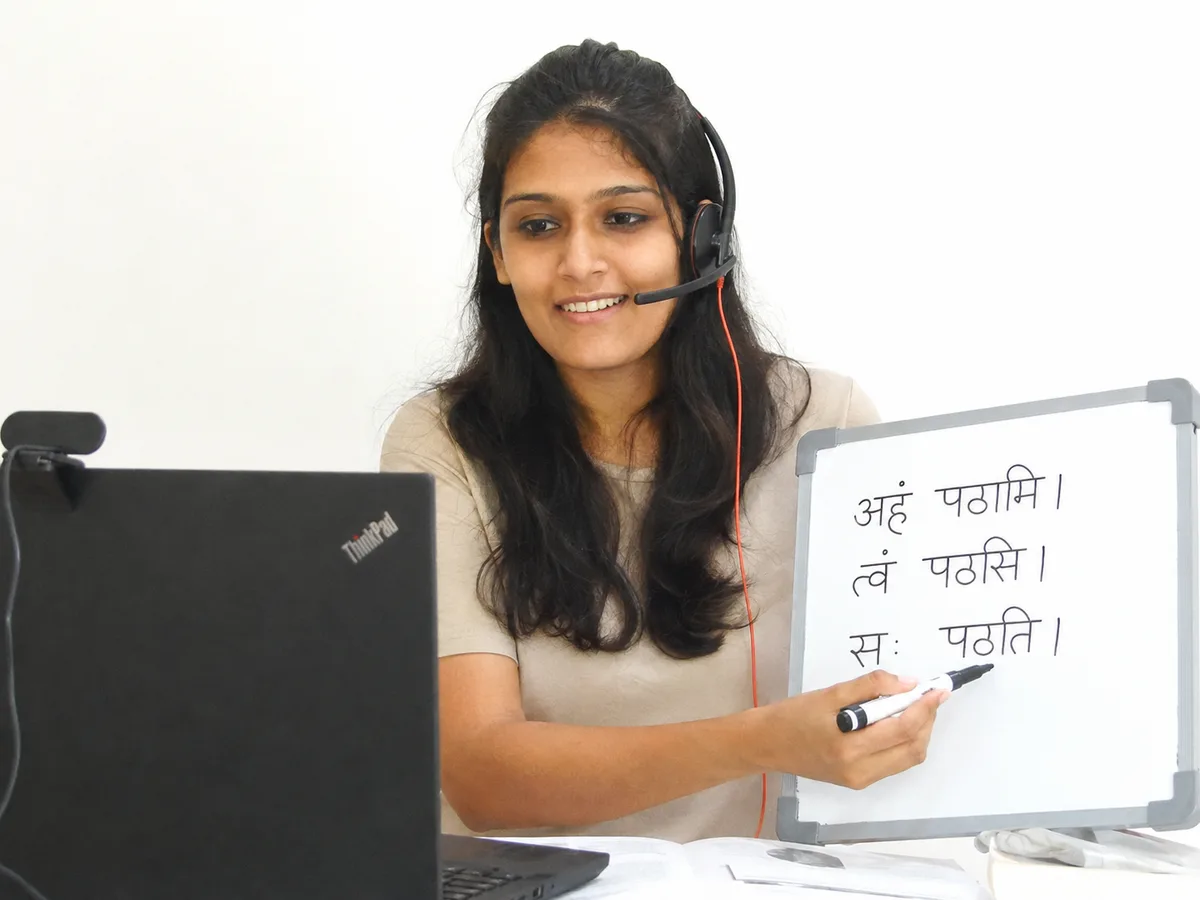
Ms. Ishita Parikh teaching Sanskrit verb forms on a whiteboard in a live online class

Certified in the text, and in the language it is written in

A great many people teach the Gītā. Rather fewer can also parse the Sanskrit and tell you why a line means what it means rather than what a translation says it means.

🕉️ Bhagavad Gītā Course: ISKCON Kurukshetra, 2024
Studied at Kurukshetra itself, where the text is set
🏛️ NPTEL “Elite” grade in Spoken Sanskrit, IIT Kharagpur
One of only 77 candidates certified nationwide. Verifiable. This is the pronunciation credential
📖 MA (Acharya) in Sanskrit, 2023
Central Sanskrit University, under the Ministry of Education
✍️ Works as a Sanskrit translator
On a machine-learning research project, where an approximate reading is not good enough

How the classes run

👥

Ten students, maximum

Small enough that everyone chants aloud and gets corrected in every class.

🕐

Twice a week, an hour

Live on Zoho Meeting, at a time arranged around your zone. How often you meet is agreed with you.

📹

Every class recorded

Which matters more here than usual, chanting needs replaying.

👩‍🏫

Always the same teacher

Every class taught by Ms. Parikh herself. No rotating tutors.

How progress is measured

Small batches mean every student's work is actually seen. Nothing here is automated. Ms. Parikh marks it herself.

What How often What it checks
In-class chanting Every class Sound, length, rhythm
Recorded chanting Weekly Returned with individual corrections
Listening test Level 1, weeks 4 and 12 Can you hear the distinctions
Verse analysis Weekly at Level 2 Splitting, parsing, meaning
Translation comparison Level 2, week 12 Interpretive judgement
Level assessment End of each level Chanting a chapter, and explaining an unseen verse
Written report End of each level Level reached, and what to work on

What it costs

One price for one hour of live teaching. It comes down as the group grows.

2 levels of 24 hours · 48 hours in total

On your own
One to one, built around you
₹399
in India
$15
outside India
per hour
Two or three of you
Learn with friends or family
₹250
in India
$12
outside India
per person, per hour
Best value
A group of four or more
Our small batch, capped at ten
₹190
in India
$9
outside India
per person, per hour
Shaped around you

You pay for the hours you take, one stage at a time, and nothing commits you to the rest. The hours are a guide rather than a fixed track: if one part of the course matters more to you, we spend longer there and move more briskly elsewhere. You can also join at whichever stage matches where you already are.

Level Hours On your own Two or three, each Four or more, each
Level 1, chanting chapters 12 and 15
Most adults start here
24 ₹9,576
$360
₹6,000
$288
₹4,560
$216
Level 2, meaning, chapter 2 24 ₹9,576
$360
₹6,000
$288
₹4,560
$216
Both levels, if you take them both 48 ₹19,152
$720
₹12,000
$576
₹9,120
$432

That last row is simply the hours added up, at ₹190 an hour in India or $9 outside India, in a group.

Your first class is free. A real lesson with Ms. Parikh, not a sales call. Nothing is paid until you have taken it and decided to carry on.

One session is one hour, so the hours above are also the number of classes. There is no second number to work out. Every session is live and recorded for you. Worksheets, marked work and a certificate of completion are included. How often you meet is arranged with you, around your timetable and ours.

Questions people ask

No. Level 1 is chanting, and it starts in roman transliteration, so you can begin on day one without reading a single Devanagari letter. The script comes later, and takes about 8 hours. Plenty of students stay at Level 1 and never learn it.

Possibly in places, and it is nothing to feel awkward about. Verses learned by ear from recordings tend to drift, long vowels shorten, retroflex and dental consonants blur, and sandhi at word joins gets smoothed away. Most of it is fixable in a handful of sessions, and you keep everything you already know.

It is a language class about a religious text. The focus is on what the Sanskrit actually says, pronunciation, grammar, and how a verse is built, rather than on preaching an interpretation. Students of every background and none are welcome, and questions about meaning are answered from the text.

Level 1 covers chapters 12 and 15, which are short, memorable and the ones traditionally learned first. Level 2 works through chapter 2, the philosophical core, word by word. Level 3 reads chapters chosen with the group, usually from 3, 4, 6, 9 and 18. If you have a chapter you particularly want, say so at the demo.

Level 1 is about 24 hours and Level 2 about 24 hours, each session 60 minutes, at a pace agreed with you. Level 3 is open-ended, because reading is a habit rather than a syllabus. You can stop after any level, each one leaves you able to do something you could not do before.

Ms. Ishita Parikh, every class. She holds an MA (Acharya) in Sanskrit from Central Sanskrit University, the NPTEL Elite grade in spoken Sanskrit from IIT Kharagpur, and a Bhagavad Gita course certificate from ISKCON Kurukshetra, completed in 2024.

One to one it is ₹399 a session in India, or $15 outside India. In a group of four or more it is ₹190 per person per session in India, or $9 outside India. Every session is 60 minutes, live, and the first class is free.See all fees.

Bring one verse you already know

A free 45-minute class, live with Ms. Parikh. Chant something you have recited for years and find out what it actually says, and whether you have been saying it right.