
Two epics, 12 sessions each
One episode a session, told in English, with its key ślokas read and translated in Sanskrit.
The Rāmāyaṇa of Vālmīki
The first poem of Sanskrit literature, book by book, from the birth of poetry to the return to Ayodhyā.
| 1 | Who is the ideal person? Vālmīki asks Nārada Bāla Kāṇḍa |
| 2 | The krauñca birds, and the first śloka ever made Bāla Kāṇḍa |
| 3 | Sītā’s svayaṃvara: the bow Bāla Kāṇḍa |
| 4 | Kaikeyī’s two boons Ayodhyā Kāṇḍa |
| 5 | Rāma leaves for the forest; Sumitrā’s words to Lakṣmaṇa Ayodhyā Kāṇḍa |
| 6 | Bharata refuses the throne: the sandals Ayodhyā Kāṇḍa |
| 7 | The golden deer, and Sītā taken Araṇya Kāṇḍa |
| 8 | The anklets, and the friendship with Sugrīva Kiṣkindhā Kāṇḍa |
| 9 | Hanumān’s leap, and Sītā in the aśoka grove Sundara Kāṇḍa |
| 10 | Vibhīṣaṇa crosses over: Rāma’s promise of refuge Yuddha Kāṇḍa |
| 11 | The Āditya-hṛdayam: Agastya’s hymn before the battle Yuddha Kāṇḍa |
| 12 | The return to Ayodhyā; you read and translate a passage Yuddha Kāṇḍa |
The Mahābhārata
The epic that holds the Gītā: its frame, its great episodes, and the counsel it ends with.
| 1 | The frame: Vyāsa, Gaṇeśa as scribe, and what the epic claims for itself Ādi Parva |
| 2 | Droṇa’s test: the bird’s eye Ādi Parva |
| 3 | The house of lac, and the escape Ādi Parva |
| 4 | The game of dice, and Draupadī’s question Sabhā Parva |
| 5 | Nala and Damayantī Āraṇyaka Parva |
| 6 | Sāvitrī argues with Yama Āraṇyaka Parva |
| 7–8 | The Yakṣa’s questions at the lake Āraṇyaka Parva |
| 9 | Vidura’s counsel to the blind king Udyoga Parva |
| 10 | Kṛṣṇa’s mission for peace; the Gītā in its setting Udyoga, Bhīṣma Parva |
| 11 | Bhīṣma on the bed of arrows: counsel to Yudhiṣṭhira Śānti Parva |
| 12 | Yudhiṣṭhira and the dog; you read and translate a passage Mahāprasthānika Parva |
Four of the ślokas you will read
Each is read aloud, put into prose order and translated word by word in the session where it falls.
मा निषाद प्रतिष्ठां त्वमगमः शाश्वतीः समाः । यत्क्रौञ्चमिथुनादेकमवधीः काममोहितम् ॥
mā niṣāda pratiṣṭhāṁ tvam agamaḥ śāśvatīḥ samāḥ | yat krauñca-mithunād ekam avadhīḥ kāma-mohitam ||
Hunter, may you find no rest for endless years, for you killed one of a pair of krauñca birds lost in love.
Rāmāyaṇa, Bāla Kāṇḍa: the first śloka
नाहं जानामि केयूरे नाहं जानामि कुण्डले । नूपुरे त्वभिजानामि नित्यं पादाभिवन्दनात् ॥
nāhaṁ jānāmi keyūre nāhaṁ jānāmi kuṇḍale | nūpure tv abhijānāmi nityaṁ pādābhivandanāt ||
I do not know these armlets, nor these earrings. The anklets I know, from bowing at her feet every day.
Rāmāyaṇa, Kiṣkindhā Kāṇḍa: Lakṣmaṇa
अहन्यहनि भूतानि गच्छन्तीह यमालयम् । शेषाः स्थावरमिच्छन्ति किमाश्चर्यमतः परम् ॥
ahany ahani bhūtāni gacchantīha yamālayam | śeṣāḥ sthāvaram icchanti kim āścaryam ataḥ param ||
Day after day, creatures go to the house of Death; those left behind want to stay for ever. What could be more astonishing?
Mahābhārata, Āraṇyaka Parva: Yudhiṣṭhira answers the Yakṣa
गुह्यं ब्रह्म तदिदं वो ब्रवीमि न मानुषाच्छ्रेष्ठतरं हि किञ्चित् ॥
guhyaṁ brahma tad idaṁ vo bravīmi | na mānuṣāc chreṣṭhataraṁ hi kiñcit ||
I tell you this secret truth: there is nothing higher than the human being.
Mahābhārata, Śānti Parva
How the classes run
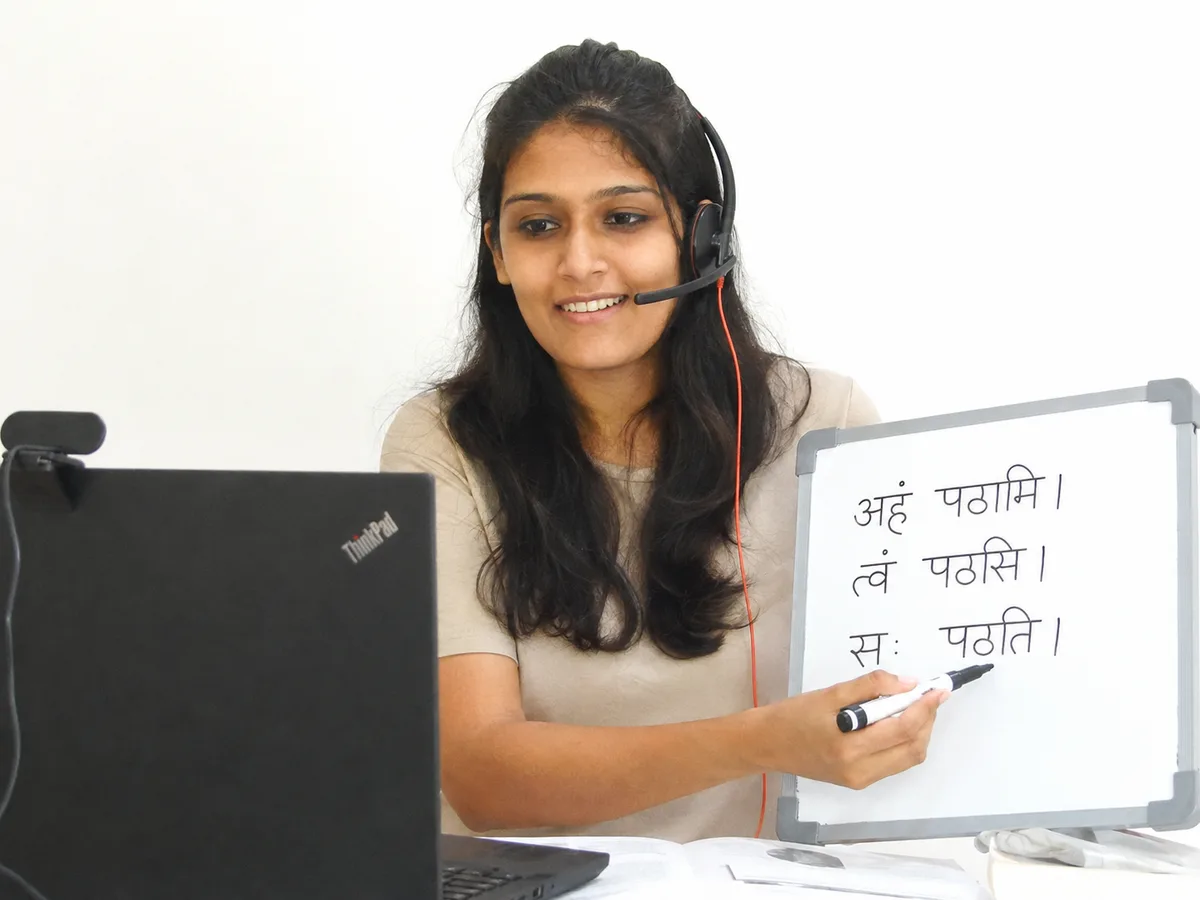
Story first, then the verse
The episode in English, then its key ślokas in Sanskrit.
Word by word
Each śloka put into prose order and translated, so you see how it is built.
Live online only
On Zoho Meeting, at times arranged around your time zone. Classes are not recorded.
Always the same teacher
Every class taught by Ms. Parikh herself. A missed class is made up with a compensation class.
How progress is measured
Small batches mean every student's work is actually seen. Nothing here is automated. Ms. Parikh marks it herself.
There is no exam. Progress is checked in the class and reported.
| What | How often | What it checks |
|---|---|---|
| Reading check | Every session | Reads the session's ślokas aloud, correctly pronounced |
| Translation | Every śloka read in full | Gives the meaning word by word |
| Track review | End of the 12 sessions | Written note: the passages read and translated |
What it costs
One price for one hour of live teaching. It comes down as the group grows.
2 tracks of 12 sessions · one for each epic
You pay for the hours you take, one stage at a time, and nothing commits you to the rest. The hours are a guide rather than a fixed track: if one part of the course matters more to you, we spend longer there and move more briskly elsewhere. You can also join at whichever stage matches where you already are. Want something different altogether? Design your own course, at the same rates.
| Track | Hours | On your own | Two or three, each | Four or more, each |
|---|---|---|---|---|
| The Rāmāyaṇa | 12 | ₹4,788 $180 | ₹3,000 $144 | ₹2,280 $108 |
| The Mahābhārata | 12 | ₹4,788 $180 | ₹3,000 $144 | ₹2,280 $108 |
| Both tracks, if you take them both | 24 | ₹9,576 $360 | ₹6,000 $288 | ₹4,560 $216 |
That last row is simply the hours added up, at ₹190 an hour per person in India, or $9 outside India, in a group of four or more. Each track stands on its own; take one or both, in either order.
One session is one hour, so the hours above are also the number of classes. There is no second number to work out. Every session is live, and taught by Ms. Parikh herself. Classes are not recorded, so if a class is missed a compensation class is arranged instead. Worksheets, marked work and a certificate of completion are included. How often you meet is arranged with you, around your timetable and ours.
Questions people ask
Do I need to know Sanskrit?
No. Every shloka comes with a transliteration and a word-by-word translation, and everything is explained in English. If you can read Devanagari, you will go faster.
Do we read the whole epic?
No. The Ramayana runs to about 24,000 verses and the Mahabharata is traditionally counted at a hundred thousand. Each session tells one episode and reads its key shlokas in Sanskrit, so by the end you know the whole story and have read its most famous verses in the original.
Which Ramayana is this?
Valmiki’s Sanskrit Ramayana. It is not Tulsidas’s Ramcharitmanas, which is in Awadhi.
Can teenagers join?
Yes, from age 12.
Can I take only one epic?
Yes. Each track is 12 sessions and stands on its own, and the two can be taken in either order.
Is this religious instruction?
No. The epics are read as literature and as the tradition tells them: what the text says, how it is built and what questions it raises. Nobody is told what to believe.
Are classes recorded?
No. Classes are live only, on Zoho Meeting, and taught by Ms. Parikh herself. If you miss a class, a compensation class is arranged.
What does it cost?
One to one it is ₹399 a session in India, or $15 outside India. In a group of four or more it is ₹190 per person per session in India, or $9 outside India. Each epic is 12 sessions, and the first class is free.
Further reading
The Gītā is part of the Mahābhārata. Not chapter 1, which is where most readers stop.
How the Vedas, the Upaniṣads and the epics relate, in plain words.
Start with a free class
A free 45-minute session, live with Ms. Parikh. Tell her which epic you would like to start with. Nothing is paid until you have had a first class.