
Six stotras in 12 sessions
Each session reads its verses aloud, corrects pronunciation, then translates word by word. Recitation is in plain classical style.
| 1 | How a stotra works: Vakratuṇḍa mahākāya and Karpūra-gauram, two verses everyone has heard · 2 verses The four quarters of a verse, sandhi, prose order, the anuṣṭubh metre |
| 2 | Gaṇeśa Pañcaratnam, the “five jewels”, traditionally attributed to Ādi Śaṅkara · Verses 1–3 The pañcacāmara metre: short-long, short-long, sixteen syllables a line |
| 3 | Gaṇeśa Pañcaratnam · Verses 4–5 and the closing verse Long compounds, read in one breath |
| 4 | Śiva Pañcākṣara Stotram, traditionally attributed to Ādi Śaṅkara · Verses 1–5 and the closing verse A verse for each syllable of na-maḥ-śi-vā-ya: how the poem is built on a name |
| 5 | Acyutāṣṭakam, traditionally attributed to Ādi Śaṅkara · Verses 1–4 The sragviṇī metre; a hymn made of names, in three different case endings |
| 6 | Acyutāṣṭakam · Verses 5–8 and the closing verse Names that tell a story: the episode behind each epithet |
| 7 | Mahālakṣmyaṣṭakam · Verses 1–8 Simple anuṣṭubh verses; the vocative, the form used to address someone |
| 8 | Nirvāṇa Ṣaṭkam, traditionally attributed to Ādi Śaṅkara · Verses 1–3 The bhujaṅgaprayāta metre; the words for mind, senses and the elements |
| 9 | Nirvāṇa Ṣaṭkam · Verses 4–6 Negation in Sanskrit (na, na ca); how the refrain closes every verse |
| 10 | Bhaktāmara Stotra, selected verses, by Mānatuṅga · Selected verses The vasantatilakā metre, fourteen syllables a line |
| 11 | All six together · All Reciting each from the sheet; the five metres side by side; reading one new verse unaided |
| 12 | Your stotra · One of the six Each learner recites and translates one stotra of their choice; how to carry on alone |
About the closing verses. Several stotras end with a verse saying what the tradition holds that reciting it brings. These are read and translated as part of the text, like any other verse. The course explains what the words say; it makes no promise about what reciting will do.
You receive verse sheets for every stotra (Devanagari, transliteration, prose order and word-by-word meaning), a guide to the five metres with the syllable pattern of each, a written note at the end of the course and a certificate of completion. Between sessions: about 15 minutes reciting the session’s verses aloud.
Four of the verses you will learn
Each is recited, put into prose order and translated word by word in the session where it falls.
वक्रतुण्ड महाकाय सूर्यकोटिसमप्रभ । निर्विघ्नं कुरु मे देव सर्वकार्येषु सर्वदा ॥
vakratuṇḍa mahākāya sūrya-koṭi-samaprabha | nirvighnaṁ kuru me deva sarva-kāryeṣu sarvadā ||
Curved trunk, great body, as bright as ten million suns: Lord, keep every task of mine free of obstacles, always.
Session 1: four quarters of eight syllables each, the anuṣṭubh
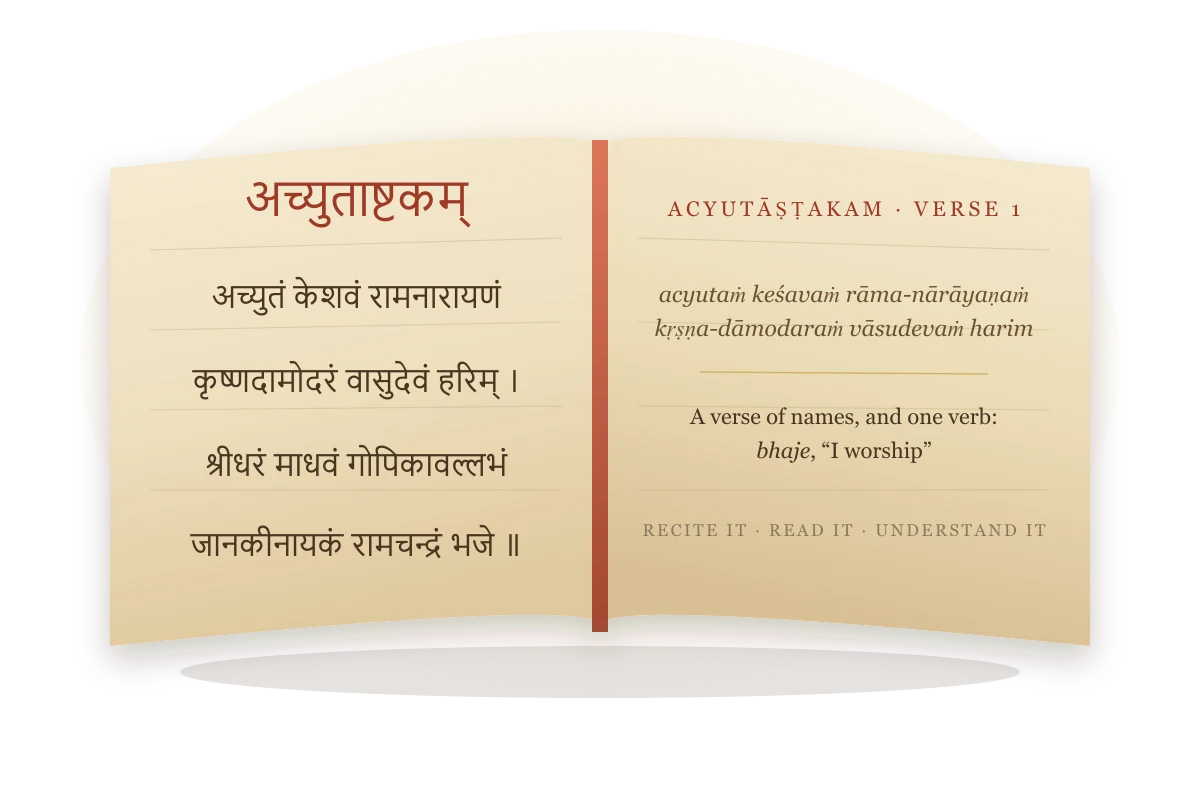
अच्युतं केशवं रामनारायणं कृष्णदामोदरं वासुदेवं हरिम् । श्रीधरं माधवं गोपिकावल्लभं जानकीनायकं रामचन्द्रं भजे ॥
acyutaṁ keśavaṁ rāma-nārāyaṇaṁ kṛṣṇa-dāmodaraṁ vāsudevaṁ harim | śrīdharaṁ mādhavaṁ gopikā-vallabhaṁ jānakī-nāyakaṁ rāmacandraṁ bhaje ||
I worship Acyuta, Keśava, Rāma, Nārāyaṇa, Kṛṣṇa, Dāmodara, Vāsudeva and Hari; Śrīdhara, Mādhava, the beloved of the gopīs, Jānakī’s lord, Rāmacandra.
Acyutāṣṭakam, verse 1: every name waits for the one verb at the end, bhaje
नमस्तेऽस्तु महामाये श्रीपीठे सुरपूजिते । शङ्खचक्रगदाहस्ते महालक्ष्मि नमोऽस्तु ते ॥
namas te ’stu mahāmāye śrīpīṭhe surapūjite | śaṅkha-cakra-gadā-haste mahālakṣmi namo ’stu te ||
Salutation to you, great Māyā, seated on the throne of Śrī, worshipped by the gods. You who hold the conch, the discus and the mace: Mahālakṣmī, salutation to you.
Mahālakṣmyaṣṭakam, verse 1: a verse spoken to someone, in the vocative
मनोबुद्ध्यहङ्कारचित्तानि नाहं न च श्रोत्रजिह्वे न च घ्राणनेत्रे । न च व्योमभूमिर्न तेजो न वायुः चिदानन्दरूपः शिवोऽहं शिवोऽहम् ॥
mano-buddhy-ahaṅkāra-cittāni nāhaṁ na ca śrotra-jihve na ca ghrāṇa-netre | na ca vyoma-bhūmir na tejo na vāyuḥ cid-ānanda-rūpaḥ śivo ’haṁ śivo ’ham ||
I am not mind, intellect, ego or memory; not the ears or the tongue, not the nose or the eyes; not space or earth, not fire or air. I am of the nature of consciousness and bliss: I am Śiva, I am Śiva.
Nirvāṇa Ṣaṭkam, verse 1: an argument made of negations
Who it is for
- People who already recite a stotra and want to know what it means and say it correctly
- Yoga teachers and students who chant at the start or end of class
- Families abroad who want to keep these hymns, and understand them, for the next generation
- People with no Sanskrit at all: everything is explained in English
- Students of Sanskrit who want to read real verse rather than textbook sentences
- Teenagers from 12, as well as adults
Not the right course if
- You want Vedic chanting with its accents (svara), which this course does not teach
- You want the Hanumān Cālīsā, which is in Awadhi, not Sanskrit: ask about a custom course
- You want the Bhagavad Gītā itself: see the Gītā for adults
- You want a full grammar course: see Sanskrit for beginners
- The learner is under 12: see shloka classes for children
How the classes run
Sound first, then meaning
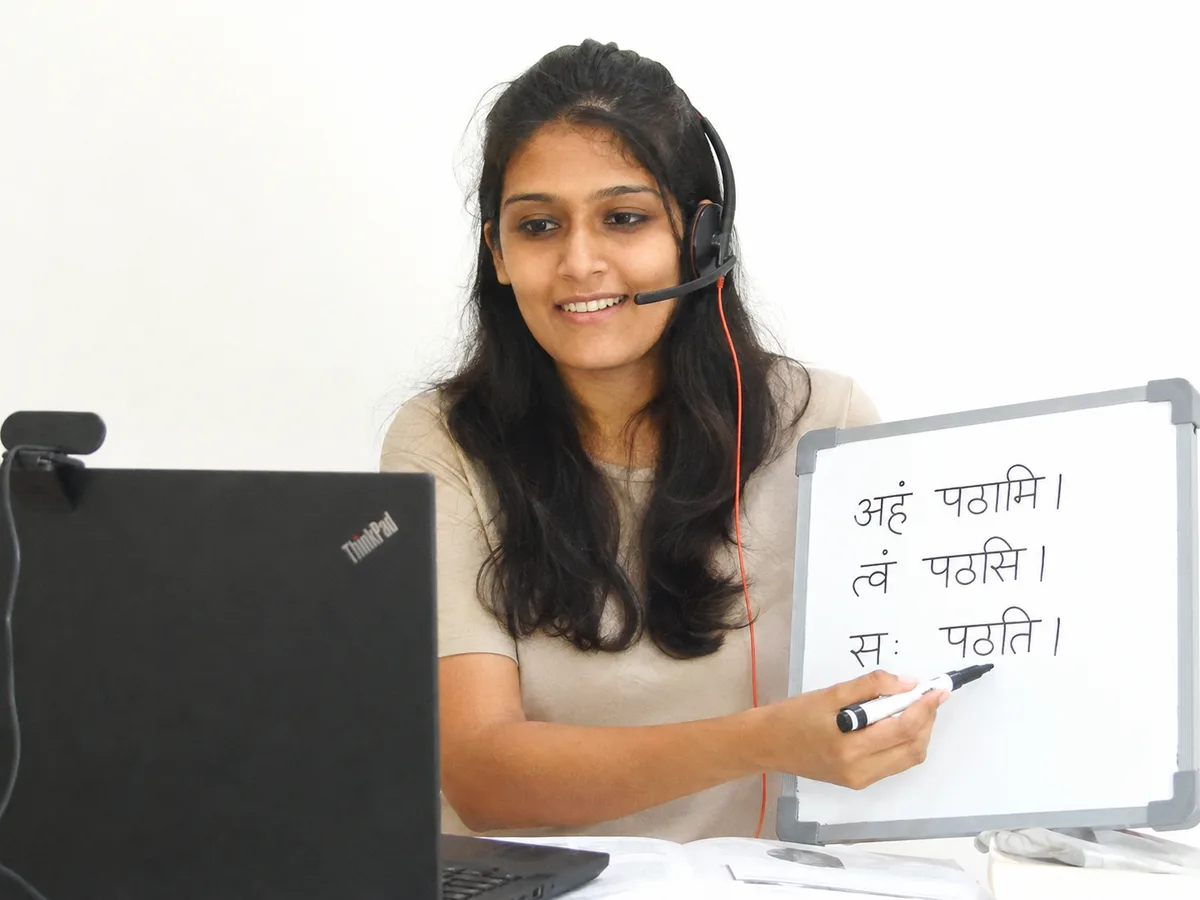
Each verse is heard and repeated until it sits right, then taken apart word by word.
The metre is tapped out
The rhythm is felt before it is explained, so you hear when a syllable is dropped.
Live online only
On Zoho Meeting, at times arranged around your time zone. Classes are not recorded.
Always the same teacher
Every class taught by Ms. Parikh herself. A missed class is made up with a compensation class.
How progress is measured
Small batches mean every student's work is actually seen. Nothing here is automated. Ms. Parikh marks it herself.
There is no exam. Progress is checked in the class and reported.
| What | How often | What it checks |
|---|---|---|
| Recitation check | Every session | Recites the session's verses with correct pronunciation and rhythm |
| Translation | Every verse | Gives the meaning word by word, in prose order |
| Course review | End of the 12 sessions | Written note: the stotras recited and translated |
What it costs
One price for one hour of live teaching. It comes down as the group grows.
12 sessions · six stotras
You pay for a block of sessions at a time, and nothing commits you to the rest. The hours are a guide rather than a fixed track: if one part matters more to you, we spend longer there and move more briskly elsewhere. Want something different altogether? Design your own course, at the same rates.
| Course | Hours | On your own | Two or three, each | Four or more, each |
|---|---|---|---|---|
| Six stotras with meaning | 12 | ₹4,800 $144 | ₹3,000 $108 | ₹2,280 $84 |
That is simply the hours added up, at ₹190 an hour per person in India, or $7 outside India, in a group of four or more.
One session is one hour, so the hours above are also the number of classes. There is no second number to work out. Every session is live, and taught by Ms. Parikh herself. Classes are not recorded, so if a class is missed a compensation class is arranged instead. Worksheets, marked work and a certificate of completion are included. How often you meet is arranged with you, around your timetable and ours.
Questions people ask
Do I need to know Sanskrit?
No. Every verse comes with a transliteration and a word-by-word translation, and everything is explained in English. If you can read Devanagari, you will go faster.
I already recite some of these. Is it still worth it?
Yes. Most people who recite from memory have learned a few words slightly wrong, and few know what each word means. Both are what this course fixes.
Is this Vedic chanting?
No. Stotras are classical Sanskrit verse, recited without the Vedic accents. Vedic chanting with svara is not taught on this course.
Can teenagers join?
Yes, from age 12. Younger children learn the daily prayers on the shloka classes for children.
Can I choose a different stotra?
The six are fixed for a group, so everyone learns together. One to one, or as a custom course, a stotra you already say at home can take the place of one of them.
Is the Hanuman Chalisa included?
No. It is in Awadhi, not Sanskrit. It can be taught for pronunciation and meaning as a custom course.
Is this religious instruction?
No. The stotras are read as Sanskrit poetry and as the tradition uses them: what each verse says, how it is built and how it is recited. Nobody is told what to believe.
Are classes recorded?
No. Classes are live only, on Zoho Meeting, and taught by Ms. Parikh herself. If you miss a class, a compensation class is arranged.
What does it cost?
One to one it is ₹400 a session in India, or $12 outside India. In a group of four or more it is ₹190 per person per session in India, or $7 outside India. The course is 12 sessions, and the first class is free.
Further reading
The six stotras of this course in the order that suits a first-time learner, and the five sounds most people get wrong.
The same sounds that trip people up in a stotra: long vowels and retroflex letters, and how to fix them.
For parents passing the prayers on: a teaching order that starts with what a child can finish.
Start with a free class
A free 45-minute session, live with Ms. Parikh. Tell her which stotras you already know. Nothing is paid until you have had a first class.